Key takeaways
- Start with a full tooling inventory, named owners, usage, and a common total-cost baseline.
- The July 2024 Microsoft-commissioned Forrester study models Power Apps benefits for a composite organization. Its results are not a ToolJet benchmark or a universal low-code saving.
- Use analyst platform assessments to inform selection, and a pilot to measure your own costs.
- Consolidate overlapping tools only after checking critical dependencies, access requirements, and migration effort.
- Compare licensing, hosting, operations, AI usage, governance, and applicable add-ons. ToolJet end-user allowances vary by plan.
- Track net benefits after transition costs; developer time saved is not automatically a cash-budget reduction.
Introduction
Reduce internal tooling costs by removing unnecessary overlap, reusing application components and data connections, and giving each tool an owner and retirement plan. Start with the complete cost baseline, test one representative consolidation, and compare the same service level after migration. The achievable saving depends on your starting stack and rollout costs.
A broad IT spending forecast does not establish your internal-tool budget. Begin with actual invoices, infrastructure usage, maintenance records, and the time spent on manual work.
But development budgets represent only the surface. The real problem hides in duplication, fragmentation, and unmanaged types of internal tools scattered across different departments.
The result is tooling sprawl, a hidden cost centre that drains engineering productivity and enterprise IT budgets.
This guide provides a practical framework for internal tooling cost reduction across low-code platforms and custom solutions. The taxonomy, audit template, and roadmap are planning tools. The worked calculation is illustrative; source-specific economic studies are identified separately. Set a target from a measured pilot rather than assuming a fixed percentage.
Security and privacy belong in the cost model. The McKinsey shadow-IT article explains how unmanaged applications introduce technical dependencies and oversight risks. Budget for access reviews, incident response, and the applicable regulatory obligations.
Why Do Internal Tooling Costs Explode at Scale?
The July 2024 Forrester TEI study commissioned by Microsoft estimates $14.7 million in three-year, risk-adjusted present-value developer efficiencies for its composite Power Apps organization. This is a modeled benefit, not annual savings across enterprises, and the study does not predict another organization’s ROI.
Tooling sprawl is the uncontrolled proliferation of internal applications, dashboards, scripts, and SaaS tools across teams without central governance or visibility.
Internal tooling expenses can grow as new applications add licenses, infrastructure, integrations, and maintenance responsibilities. Growth varies with the architecture and operating model; a headcount threshold alone does not imply exponential cost. Map shared dependencies and recurring work before estimating the opportunity.
- Teams build duplicate tools independently
- No central tool catalog exists
- Shadow IT bypasses procurement governance
- Vendor lock-in blocks tool consolidation
- Integration overhead compounds with scale
The transition from team-level decisions to enterprise-wide cost modeling reveals the true magnitude of this problem. Enterprises that continue to rely on spreadsheets instead of apps often face even steeper hidden costs across every department and function.
The True Cost of Internal Tools
A low-code platform market forecast measures a broad market, not the cost of enterprise internal tooling or the saving your organization can obtain. Use operational and financial records for the baseline below.
Hidden internal tooling cost is any expense generated by internal tools that does not appear in traditional development or licensing budgets, including productivity losses, coordination overhead, and knowledge attrition. Most enterprises measure tooling costs only through direct spend like developer salaries, hosting, and licenses.
The true cost also includes the five operational dimensions below. Measure their effect instead of assuming they double or triple the visible budget. This is particularly relevant when building secure dashboards or managing distributed data.
Tool-sprawl discussions help identify questions to investigate. Your audit should establish the number of applications, active users, duplicate capabilities, and actual spend rather than applying an unsourced average to your organization.
- Cognitive load drains developer focus
- Coordination overhead multiplies with fragmentation
- System friction creates manual workarounds
- Change management triggers retraining cycles
- Knowledge loss turns tools into blackboxes
These hidden costs explain why the visible tooling budget is only a fraction of actual enterprise tooling spend. A structured cost taxonomy maps every dimension and gives finance leaders a shared vocabulary for reduction.
Cognitive load cost is time spent by developers switching between disconnected systems and reconstructing context. Record the steps required for common tasks across internal tools, then measure whether a shared interface or integration reduces that effort.
- Context-switching reduces deep work capacity
- Information silos increase decision latency
- Redundant data entry wastes hours
- UI inconsistency slows employee onboarding
- Mental fatigue degrades code quality
A shared low-code platform can provide reusable interfaces and data connections. It reduces context-switching only when the resulting applications simplify the actual workflow; measure task completion and support demand after the change.
Coordination Overhead in Enterprise Tool Stacks
Market research can provide adoption context. The platform decision still needs workload, portability, governance, and total-cost evidence for your own enterprise.
Coordination cost is the organizational overhead of aligning multiple teams, tools, and workflows to deliver a single business outcome. As tooling fragments, sales teams and HR departments spend more time coordinating across systems than building value.
- Cross-team dependencies increase overhead
- Inconsistent APIs require custom integrations
- Documentation gaps slow team collaboration
- Tribal knowledge creates team bottlenecks
- Escalation paths differ across tools
Enterprises that consolidate onto a unified platform with shared connectors and standardized workflows can reduce coordination costs by eliminating the handoff friction that fragments create between departments.
System Friction in Internal Tool Stacks
System friction cost is the cumulative delay caused by incompatible tools, broken integrations, and manual workarounds across the internal tool stack. When tools do not communicate natively, teams resort to CSV exports and workaround scripts. Each workaround adds latency and error risk.
- Incompatible tools force manual transfers
- Broken integrations delay critical workflows
- Workaround scripts accumulate technical debt
- Data inconsistency erodes decision quality
- Manual processes block real-time operations
Organizations that build tools on existing databases can dramatically reduce this friction by connecting directly to their data layer through a platform with native connectors.
Change Management Costs for Internal Tools
Change management cost is the expense of training, migrating, and adapting teams when internal tools are updated, replaced, or consolidated. Every tool change triggers a wave of retraining, documentation updates, and temporary productivity loss.
- Tool migrations require planning, testing, and owner time
- Retraining slows team output temporarily
- Documentation updates lag behind changes
- Temporary productivity dips affect deadlines
- Resistance to change stalls adoption
Estimate migration effort from the affected queries, integrations, authentication, user training, and cutover plan. Reusable components and release conventions can reduce repeated work, but each application still needs validation.
Knowledge Loss in Internal Tool Teams
Knowledge loss cost is the institutional intelligence that disappears when employees who built or maintained internal tools leave the organization. When the engineer who built an internal tool leaves, the organization loses the tribal knowledge embedded in that system.
- Undocumented tools become risky blackboxes
- No one dares modify legacy systems
- Institutional memory walks out the door
- Tool retirement becomes politically impossible
- New owners need documentation and a supported handover
Platforms like ToolJet provide visual applications, reusable patterns, and query definitions that can support a handover. Keep owner records, runbooks, data contracts, and release instructions alongside the app; the interface does not automatically explain every business rule.
Internal Tooling Cost Taxonomy
The Forrester Wave is a platform assessment, not a universal savings calculator. The separate Microsoft-commissioned Power Apps TEI study models 206% three-year ROI for its composite organization. Use its method to ask questions, not its result as a promise for another product or deployment.
An internal tooling cost taxonomy classifies the expenses of building, running, changing, scaling, securing, and retiring applications. The six-category model below is an editorial planning framework that gives platform teams and finance a shared vocabulary; it is not a validated proprietary financial standard.
If your organization is currently mapping internal tools or trying to quantify tooling spend, it may be worth running a structured audit first.
Many platform teams start by modelling the cost equation outlined above and then evaluating whether a unified internal tool platform like ToolJet could consolidate several existing systems.
| Cost Category | What It Includes | Reduction Strategy |
| Build Costs | Salaries, design, prototyping, QA | Pilot visual building and reuse; measure implementation and QA hours |
| Run Costs | Hosting, monitoring, incident response | Consolidate onto shared infrastructure |
| Change Costs | Updates, migrations, retraining | standardized component libraries |
| Scale Costs | Performance, capacity, load balancing | Test capacity, query design, and operating costs at target load |
| Risk Costs | Security audits, compliance, patching | Reuse controls and evidence; retain required security reviews |
| Exit Costs | Decommissioning, data migration | Lifecycle management from day one |
This taxonomy feeds directly into the cost equation, which gives enterprises a formula for calculating and reducing total tooling spend across all six categories.
The Internal Tooling Cost Equation
Use the same time period and service requirements for every cost category. Calculate the baseline and the proposed deployment separately, including license fees, AI usage, infrastructure, support, staff time, and retirement work. Record assumptions and distinguish cash spend from the value of time released for other work.
- Choose one evaluation period and define the applications and service levels included.
- Record actual build, run, change, scale, risk, and exit costs for the baseline.
- Model reuse and standardization as changes within those categories, not additional deductions.
- Add one-time migration, training, and cutover costs separately from ongoing operations.
- Compare the forecast with pilot measurements and revisit assumptions after rollout.
Total Cost = Build + Run + Change + Scale + Risk + Exit.
Illustrative one-year calculation (USD): assume an existing stack costs $120,000 and a proposed stack costs $95,000 per year across the same six categories, including staff time, licensing, AI usage, infrastructure, and support. Add $15,000 in one-time migration and training costs, giving $110,000 in the first year. The estimated first-year reduction is ($120,000-$110,000)/$120,000 = 8.3%; a later year without those transition costs would be 20.8% if all other assumptions held. These are hypothetical inputs, not measured ToolJet results or a vendor quote. Avoid counting the transition costs again in recurring change costs.
Build a total-cost estimate using the taxonomy, assumptions, and a representative pilot. Compare the costs of the existing stack, the transition, and ongoing operations.
Book a ToolJet demo to get a personalised cost reduction assessment for your organization.
Strategic Framework to Reduce Tooling Costs
The five-layer framework combines consolidation, platformization, standardization, automation, and governance. Apply the layers where the inventory shows avoidable work or duplicated spend; measure each intervention rather than assuming the savings compound automatically.

Layer 1: System Consolidation
System consolidation audits overlapping tools and evaluates whether they can share capabilities or be retired. For teams considering migrating from Retool, compare the replacement app and operating model before committing. License changes alone do not establish immediate net savings.
- Audit all existing tool inventories
- Map functional overlap across categories
- Review low-usage tools for retirement after checking critical dependencies
- Merge overlapping tools onto one platform
- Block new procurement without approval
Establishing a central tool registry prevents duplication from recurring after the initial consolidation effort and gives procurement teams a single source of truth for all tooling decisions.
Layer 2: Platformization
Internal Developer Platforms (IDPs) are enterprise platforms that provide shared infrastructure, tooling, and workflows for developers to build internal applications faster while maintaining security and governance standards.
Platformization is the strategy of replacing scattered point solutions with a unified internal development platform that provides shared infrastructure, components, and services. Instead of each team building from scratch, platformization creates a shared foundation.
- Deploy shared low-code platform for teams
- centralize authentication and access control
- Provide pre-built data source connectors
- Implement shared monitoring and logging
- Enable self-service creation with guardrails
A shared platform can spread common infrastructure and onboarding work across applications. Account for the platform team, capacity, access configuration, and any migration effort; compare the per-tool cost before and after the pilot.
Layer 3: standardization
Tooling standardization is the practice of enforcing consistent design patterns, component libraries, and development protocols across all internal tool development. standardization reduces change costs and accelerates onboarding by ensuring every tool follows predictable patterns.
- Create reusable UI component libraries
- Define standard data model contracts
- Enforce naming and documentation conventions
- Mandate security and compliance baselines
Publish internal development best practices
Use low-code platform research and reviews to identify evaluation questions. Validate standards for query design, component reuse, release promotion, and ownership against the specific product and plan.
Layer 4: Automation
Tooling automation is the application of CI/CD pipelines, automated testing, monitoring, and AI-assisted development to reduce manual effort across the internal tool lifecycle. Automation compounds savings by reducing run costs and eliminating repetitive work.
- Automate deployment pipelines for apps
- Implement automated testing per release
- Use AI-assisted generation for patterns
- Configure automatic alerting and response
- Schedule automated usage cost reporting
Automated tests and deployment checks can apply standards consistently. They still need an owner, exception handling, and monitoring. Compare the time saved with the cost of building and maintaining the automation.
Layer 5: Governance
Tooling governance defines how applications are proposed, approved, deployed, reviewed, and retired. For product managers and platform leads, it establishes ownership and budget responsibility. Evaluate its effect alongside consolidation and process changes.
- Establish cross-functional review boards
- Require business case for new tools
- Implement quarterly usage and ROI reviews
- Define clear ownership and accountability
- Mandate sunset dates and decommissioning
Without ownership and review, duplicated tools can return. Audit logging and role-based access support oversight when configured for the selected plan; they do not replace approval and retirement processes. The #lowcode discussion can provide examples to assess against your own operating requirements.
Use a representative app to evaluate ToolJet’s visual builder, integrations, deployment, and governance. Start free with ToolJet to test the builder; include the paid governance capabilities and applicable add-ons in the production estimate.
Low-Code Platforms That Reduce Internal Tooling Costs
Low-code platforms combine visual interfaces, data connections, and reusable application logic. These capabilities can change the work needed to build and maintain internal tools, but their net economic effect depends on the application, deployment, and operating process.
- Build: measure implementation, review, and QA hours for a representative app.
- Run: compare hosting, monitoring, incidents, support, and usage fees.
- Change: measure update effort and whether reusable components reduce duplication.
- Scale: test query behavior, capacity, concurrency, and costs at the planned load.
- Risk: review identity, permissions, logging, patching, and audit responsibilities.
ToolJet offers an open-source, self-hostable app platform and 100+ integrations. Current plan allowances are 50 end users on Free, Basic, and Pro; 100 on Team; and unlimited on Enterprise. Advanced SSO, custom groups, audit logs, and GitSync are available on Team and Enterprise. Review security reports and the selected deployment rather than treating a platform purchase as automatic compliance.
For enterprises evaluating options, ToolJet vs Retool can help compare app building, plan allowances, and deployment. Use a same-scope cost model and a representative pilot to determine the fit.
How do Internal Tooling Cost Savings Compound?
Reuse and standardization can reduce repeated implementation and change work as more teams adopt shared components. Track whether those benefits exceed new platform, support, and operating costs; adoption alone does not establish a fixed saving.
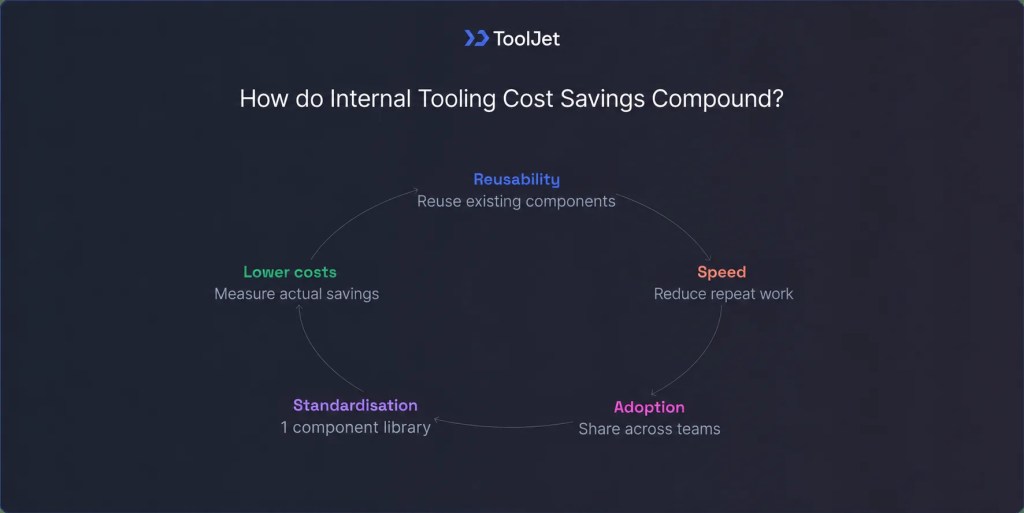
- Reusability: teams build shared components
- Speed: new tools ship using existing
- Adoption: fast delivery attracts more teams
- standardization: more teams means consistency
- Lower costs: standardization compresses spend
Each revolution of this flywheel compounds savings. Teams across retail, marketing, finance, operations, and back office functions benefit most when workflows are validated before any build begins.
Architecture Patterns That Reduce Tooling Spend
Enterprise architecture patterns for tooling cost reduction are structural design principles that minimize duplication, maximize shared services, and enable modular internal tool development.
- API-first design enables tool interoperability
- Shared services eliminate redundant backends
- Modular platforms allow incremental builds
- Internal developer platforms reduce overhead
- Event-driven architectures decouple dependencies
These architecture patterns can support cost-efficient tooling. Teams using AI-assisted low-code platforms should still define APIs, access boundaries, component ownership, and release checks; generated apps do not automatically enforce the enterprise architecture.
organizational Design for Cost Efficiency
organizational design for tooling cost efficiency is the practice of structuring teams, roles, and reporting lines to minimize duplication and align tooling decisions with enterprise cost objectives. This is critical for engineering leaders, IT heads, and AI managers making platform decisions. Conway’s Law states that organizations design systems that mirror their communication structures.
- Platform teams own shared infrastructure
- Centers of Excellence provide standards
- Federated governance balances team autonomy
- Shared ownership prevents orphaned tools
- Citizen developer programs expand capacity
Teams using internal tool builders and enterprise access management can assign app ownership and shared standards. The Stack Overflow Developer Survey offers broader developer context. Combine feedback from your teams with measurements of task completion, maintenance, and tool-switching effort.
Tooling Governance Framework for Cost Control
Governance contributes to cost control by assigning owners, recording decisions, reviewing usage, and planning retirement. Match the process to risk and business importance so that oversight supports delivery instead of adding unnecessary approval work.
- Tool approval workflows prevent procurement
- Usage tracking identifies redundant tools
- Mandatory sunset reviews enforce decommissioning
- Security policy enforcement reduces risk
- Budget attribution links costs to outcomes
Governance helps protect gains by reviewing new tools and existing dependencies. Community discussions on r/lowcode can suggest approaches to test. Name decision owners, document exceptions, and measure the effect of your own review process.
Process Re-Engineering for Cost Reduction
Process re-engineering for tooling cost reduction is the practice of redesigning business processes before building tools, ensuring tools serve optimised workflows rather than automating existing inefficiencies. The most expensive mistake is building a tool for a broken process.
- Map existing processes before scoping tools
- Eliminate unnecessary steps before automating
- standardize processes across departments first
- Validate requirements against lean outputs
- Implement continuous process review cycles
Teams that build internal apps without frontend developers still need to validate their process design before building. Process-first, tools-second prevents enterprises from digitizing waste.
The Internal Tooling Lifecycle Model
The internal tooling lifecycle model below has five stages: build, deploy, scale, standardize, and retire. Assign costs and an accountable owner to each stage, and revisit the plan as application requirements change.
- Build: define requirements and validate fit
- Deploy: release with monitoring in place
- Scale: expand users and optimise performance
- standardize: align with enterprise governance
- Retire: decommission with data migration
Without lifecycle management, tools accumulate indefinitely. This directly feeds the decommissioning gap problem, one of the most underestimated cost drivers in enterprise tooling spend.
ToolJet supports application building and release management. Your organization still owns inventory, operating procedures, data retention, and retirement decisions. Start building today with a representative app and a documented lifecycle plan.
Cost Observability for Internal Tools
Cost observability for internal tools is the practice of implementing real-time tracking, attribution, and reporting systems that make every dollar spent on internal tooling visible, measurable, and actionable. You cannot reduce what you cannot measure.
- Tool usage analytics reveal actual adoption
- Cost attribution maps expenses to units
- Value mapping connects usage to outcomes
- ROI modeling quantifies return per tool
- Automated reports surface waste and anomalies
Apply FinOps practices such as cost allocation, forecasting, and usage optimization to the relevant technology spend. For ToolJet applications, collect license and infrastructure costs alongside application usage and owner records. IT leaders can combine app telemetry, financial records, and business measures to evaluate each application.
The McKinsey shadow-IT article describes business and IT working together with guardrails, reusable services, and an operating model. Use that guidance alongside a process review; it does not provide a universal cost-saving result for ToolJet.
The Enterprise Internal Tool Decommissioning Gap Problem
The decommissioning gap is the persistent organizational failure to retire internal tools after they have been replaced, resulting in compounding run, risk, and maintenance costs on legacy systems. Tools are born daily but almost never die, especially in healthcare and education where regulatory overhead compounds the problem.
- No one owns the decommissioning decision
- Data migration risks create paralysis
- Legacy dependencies remain fully undocumented
- Fear of breaking workflows blocks retirement
- Budget inertia keeps line items active
When evaluating platforms or reviewing feedback on TrustRadius, check what happens to the applications being replaced. Name a retirement owner, document data migration and downstream dependencies, and schedule access and audit reviews appropriate to the plan. Combine audit evidence with actual usage and financial records.
Common Mistakes That Prevent Cost Reduction
Common cost reduction mistakes are the recurring organizational behaviors and decisions that undermine or reverse tooling cost savings despite active optimization efforts. Even enterprises with strong intentions fall into predictable traps.
- Tool sprawl creates redundancy everywhere
- Shadow IT bypasses cost governance entirely
- Over-customisation resists standardization efforts
- Platform fragmentation negates consolidation benefits
- No ownership models accumulate debt
Consolidation gains can be lost when new tools bypass the agreed inventory and review process. Track spend and maintenance against the baseline, including exceptions, so that the organization can respond before duplication grows.
ToolJet’s predefined roles support basic access control. Team and Enterprise add advanced SSO, custom groups, audit logs, and GitSync. Configure those controls for the intended deployment and pair them with an app inventory and review process.
See how access controls and audit evidence can support your platform team’s governance process. Approval policy and exception handling remain organizational responsibilities.
Internal Tool Consolidation Audit Template
Before launching any cost reduction initiative, enterprises need a clear inventory of every internal tool in their stack. This audit template provides the structured format that engineering leaders and product managers need to evaluate each tool against consolidation criteria.
| Field | What to Capture |
| Tool name | Application or service name |
| Team owner | Department or individual responsible |
| Monthly active users | Actual usage, not licensed seats |
| Infrastructure cost | Hosting, licensing, and support spend |
| Maintenance hours per month | Developer time for upkeep |
| Overlapping functionality | Other tools serving similar purpose |
| Retirement feasibility score | 1 to 5 rating based on dependencies |
Treat retirement feasibility and active usage as inputs to a review, not automatic deletion rules. Low-usage applications may serve a critical control or dependency. Confirm ownership, retention, migration work, and fallback requirements before using the consolidation framework to prioritize candidates.
Roadmap to Reduce Internal Tooling Costs
The enterprise execution roadmap is a seven-phase operational plan that guides organizations from initial tool audit through full cost optimization, with clear milestones and accountability at each phase. Strategy without execution is just a slideshow.
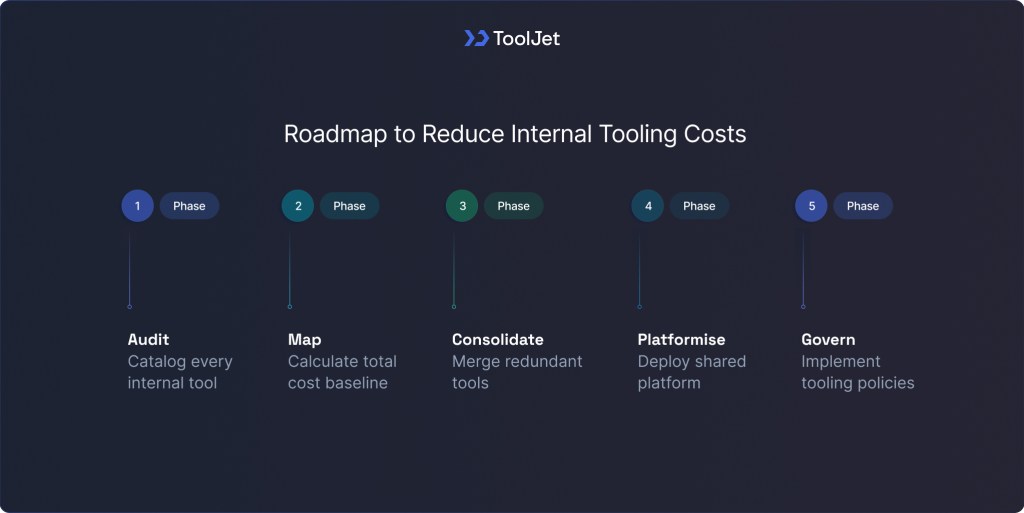
- Phase 1 Audit: catalog every internal tool
- Phase 2 Map: calculate total cost baseline
- Phase 3 Consolidate: merge redundant tools
- Phase 4 platformize: deploy shared platform
- Phase 5 Govern: implement tooling policies
Phase 6 establishes cost and usage reporting; Phase 7 compares observed outcomes with the baseline. Give the pilot a defined workload and evaluation period, then record build time, incidents, maintenance, adoption, and transition costs. The payback date follows from those measurements, not a universal 90-day promise.
Audit fragmented tools, select a representative app, and evaluate an open-source app platform against your controls and operating model. Talk to our team about deployment, support, and a cost model for your intended rollout.
Signs Your Tool Stack Needs a Cost Audit
The following signals identify areas worth investigating. Their financial impact depends on critical dependencies, the maintenance baseline, and the work needed to consolidate or retire applications.
- Multiple teams building similar tools today
- No central catalog of tools exists
- Legacy tools remain without retirement plans
- Tool procurement lacks centralized approval
- Maintenance work competes with delivery and lacks a measured baseline
If several signs apply, investigate the corresponding costs and dependencies. Teams evaluating low-code platforms can test one representative application before committing to a broader consolidation. Use actual spend and migration estimates to prioritize the opportunity.
How ToolJet Helps Reduce Internal Tooling Costs?
Internal tool ROI measures the business value generated by internal applications relative to the total cost of building, operating, and maintaining them across their lifecycle.
ToolJet combines AI app generation, visual editing, reusable components, and data connections for internal applications. Use a pilot to estimate the work saved and the work still required for queries, permissions, testing, and operations. Team includes 3,000 AI credits per builder; model the usage beyond the included allowance in the rollout estimate.
- AI Agent Builder and Workflows are Self-hosted only; evaluate their automation steps and operating requirements.
- ToolJet Database can store application data, while external systems, backups, and permissions still need planning.
- SSO and access control: predefined roles across plans; advanced SSO and custom groups on Team and Enterprise.
- Workflow automation on Self-hosted can reduce repetitive steps; measure the net effect and review execution permissions.
- Free, Basic, and Pro include up to 50 end users; Team includes 100; Enterprise includes unlimited end users. Free has unlimited pages.
ToolJet’s plans and pricing are updated periodically. For current plan details and limits, see ToolJet’s Pricing here
ToolJet provides an open-source app platform with commercial enterprise capabilities. Evaluate security reports and compliance scope alongside your configuration, access controls, and contractual requirements. Private/custom connectors, a customer-hosted AI gateway, and air-gapped deployment require the relevant Self-hosted Enterprise configuration or add-ons; those capabilities are not available on ToolJet Cloud. Enterprise BYOK is available on both ToolJet Cloud and Self-hosted deployments. For education and SaaS teams, deployment and support requirements should be part of the decision. The ToolJet vs Appsmith breakdown can inform a product-specific comparison.
Conclusion
Enterprise tooling costs compound silently through duplication, fragmentation, and ungoverned procurement. The organizations that reverse this trend treat cost reduction as a system design problem, not a budget exercise.
Consolidation, reuse, automation, and governance can support a maintainable application portfolio. ToolJet offers an open-source app platform with Cloud and Self-hosted deployment. Source access does not by itself establish data isolation, managed inference location, or full ownership of every connected service.
ToolJet combines 100+ integrations with plan-specific user allowances and security capabilities. Compare the deployment, governance, usage, support, and staffing costs needed for your application portfolio.
Report the change in total cost over the same period and service requirements, including transition costs and any work transferred to a platform team. The framework is useful across products; teams that start a representative pilot can replace assumptions with measured implementation and operating data.
Get Started With ToolJet
Evaluate a representative internal app with ToolJet’s open-source platform, visual editing, and integrations. Record the costs, controls, and maintenance work before deciding how broadly to consolidate.
 Table of contents