Key takeaways
- Utilize Google Sheet to web app converters for simple enterprise grade internal tools.
- Building enterprise grade internal tools without frontend developers increases efficiency by 30% for teams.
- Python web apps without JavaScript reduce development time by 40%.
- No-code enterprise grade platforms enable 70% faster deployment of internal tools.
- Automate workflows to save 20 hours of manual developer work weekly.
- Streamline development processes with 50% fewer errors using low-code platforms.
Do You Know?
Globally, 31% of companies use low-code at the core of their software strategy.
The 2026 enterprise landscape demands extreme agility and immediate digital execution. By leveraging modern systems to build internal tools without front end developers, organizations can bypass traditional hiring bottlenecks and deliver high-performance internal software at scale. Modern engineering leaders are moving toward “vibe coding” and autonomous systems to maintain a competitive edge. This shift allows backend teams to build internal tools without frontend developers by utilizing intuitive drag-and-drop interfaces that connect directly to core data logic.
- Accelerate Low-code development platform adoption.
- Utilize an Internal tool builder.
- Implement a No-code app builder.
- Enhance enterprise SaaS internal ecosystems.
- Centralize fragmented InternalTools resources.
- Empower backend engineering teams.
Do You Know?
In the coming years, 75% of all new enterprise applications will be built using low-code or no-code technologies, representing a massive shift from traditional development.
Why Enterprises Must Build Internal Apps Without Front-End Developers?
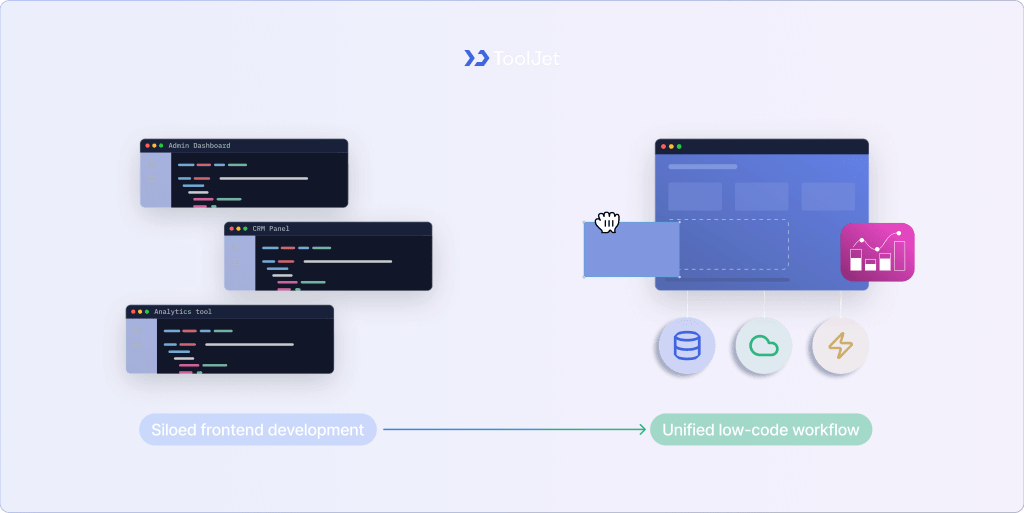
Choosing the right ecosystem allows your team to build enterprise grade internal tools without front end developers while maintaining deep data integrity. Global technology spend is projected to grow by 7.8% in 2026, reaching $5.6 trillion as businesses prioritize AI-driven low code and automation investments. By adopting unified platforms, organisations can now bridge the gap between backend logic and intuitive user interfaces.
- Utilize an internal tool builder like ToolJet, Superblocks etc.
- Enhance enterprise SaaS internal ecosystems.
- Centralize fragmented InternalTools resources.
- Empower backend engineering teams effectively.
- Modernize every low-code development platform.
- Standardize visual no-code app builder logic.
Boost your engineering velocity today. Explore our Low-Code Tutorials to master rapid internal application deployment.
ToolJet Comparison: A Better Way to Build Internal Tools Without Front End Developers
When evaluating how to build internal tools without front end developers, ToolJet offers a superior alternative to legacy coding such as Superblocks, PowerApps, and more. Unlike other Retool alternatives, it provides a seamless ToolJet open source experience that balances power with a no-code simplicity. In 2025, TypeScript overtook Python and JavaScript as the most used language on GitHub, driven by its reliability in AI-assisted coding and agentic dev tools scaffolding.
- Switch to ToolJet open source or evaluate premium ToolJet alternatives fairly.
- Evaluate modern dev tools capabilities.
- Prioritize low code efficiency metrics.
- Minimize no code design constraints.
- Review top low-code platform alternatives performance fairly (eg. speed, scalability, etc.).
- Standardize internal interface designs.
Tooljet vs. Traditional Development
| Metric | Traditional Dev | Low-Code (ToolJet) |
|---|---|---|
| Development Cost | 100% (Base) | 30% |
| Developer Effort | High | Minimal |
| UI Consistency | Variable | Standardized |
Adopting low-code solutions like ToolJet enhances internal tool development, making processes agile and reducing overhead. Between 2020 and 2025, the number of developers on GitHub in countries like India, Brazil, and Indonesia more than quadrupled (400%+ growth). This has fundamentally shifted where and how internal tools are built.
Explore our other blogs to learn more about low-code alternatives like Superblocks alternatives and many more .
Do You Know?
Since 2020, the developer community in emerging markets has surged by over 400%, fundamentally changing how software is built. This shift enables a new era of “vibe coding,” where anyone can use natural language to scaffold complex internal tools in record time. One notable trend in 2025 was “vibe coding.” First coined by Andrej Karparthy
You can also dive into ToolJet’s capabilities to automate workflows, create client portals, and build Python web apps without JavaScript.
Why Choose Low-Code to Build Internal Tools Without Front-End Developers?
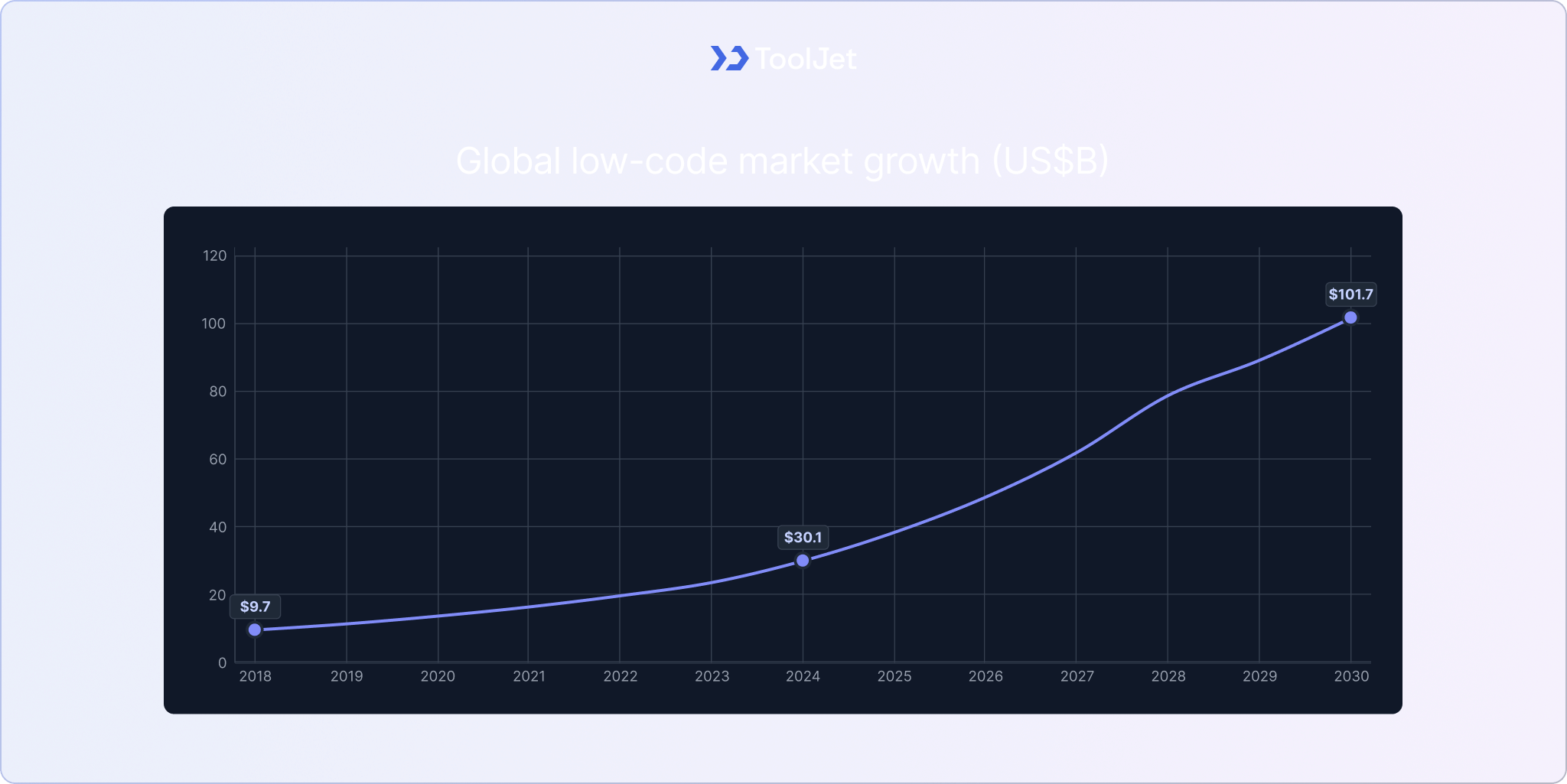
With the global market growing to $101.7 billion by 2030 and 75% of new applications using these technologies by 2026, low-code trends point to massive growth. Choosing the right ecosystem allows your team to build internal tools without front end developers while maintaining deep data integrity. You can easily create a SQL to admin panel bridge or convert a Google Sheet to web app in minutes, effectively creating Python web apps without JavaScript. By a couple of years, 30% of enterprises will automate more than half of their network activities, significantly reducing errors in internal tools management.
- Create a secure Database to UI bridge.
- Build Python web apps without JavaScript.
- Map any SQL to admin panel.
- Sync your Google Sheet to web app.
- Properly automate internal workflows immediately.
Do You Know?
Organizations utilizing low-code platforms report an average annual savings of $187,000 per enterprise-grade application.
Cost Reduction Strategies to Build Internal Tools Without Front End Developers
Enterprises can slash overhead costs when they build internal tools without front end developers by using a dedicated Admin panel generator. Enterprise applications are evolving into digital workforces where 30% of vendors will launch Model Context Protocol (MCP) servers to allow AI agents to automate internal workflows. Whether you are comparing Appsmith vs Budibase or looking for a MongoDB GUI builder, the goal is to turn spreadsheets into apps using a CRUD app builder.
- Slash front-end specialist hiring costs.
- Reduce long-term technical debt costs.
- Optimize your internal app development.
- Adopt Low-code development platform standards.
Do You Know?
Research shows that low-code solutions can cut development costs by up to 70% compared to traditional methods, allowing companies to break even within months.
How to Build Internal Apps Without Front-End Developers and Maximize Sprint Speed
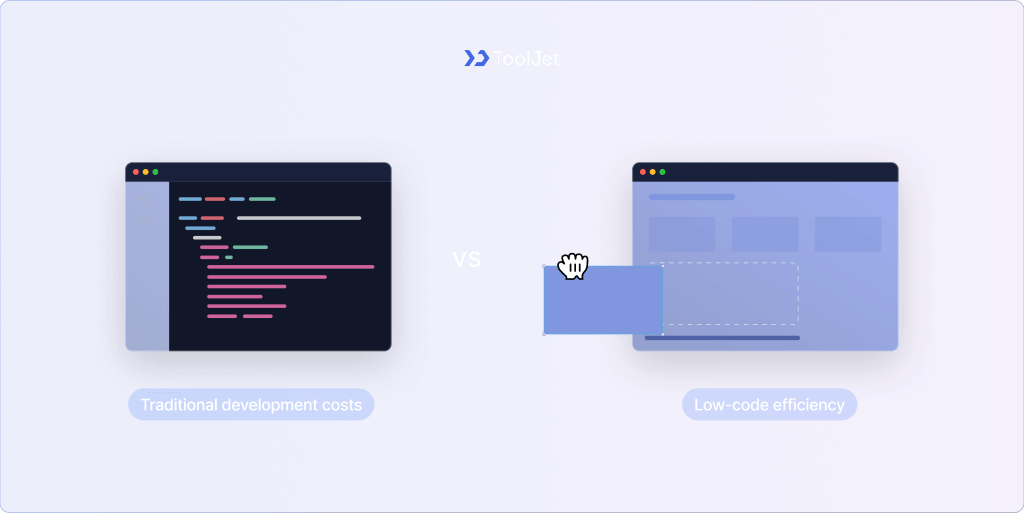
Low-code platforms like ToolJet significantly reduce development cycles. They enable rapid prototyping and deployment.
Sprint velocity increases dramatically when teams bypass the traditional UI design-to-code bottleneck. To hit deadlines, build internal tools without frontend developers using an AI app generator from text. By leveraging automation and pre-built components, organizations can move from concept to deployment in hours rather than weeks.
- Collapse the design-to-code gap.
- Bind data to UI instantly.
- Prototype rapidly with live logic.
- Publish via one-click deployment.
- Scaffolding via AI app generators.
Flexibility and Customization with Low-Code Enterprise Solutions
Maintaining flexibility is vital when you build internal tools without front end developers for a complex SaaS environment. Using a high-end low-code platform allows for a custom client portal while keeping your DevTools and InternalTools unified and secure.
- Launch a custom client portal.
- Enforce enterprise security and compliance.
- Scale global InternalTools instances.
- Refine low-code platform permissions.
- Enable deeply customized business logic.
Building Low Code Internal Dashboards Without Frontend Developers
Data-driven teams need to build internal tools without frontend developers to visualize real-time insights via Internal dashboards. By automating a Database to UI pipeline and using ToolJet open source, you can transform raw data into a no code powerhouse.
Do You Know?
Specialized AI tools for work management are projected to see up to 2,400% growth in 2026 as organizations move toward task-specific automation.
- Generate real-time Internal dashboards.
- Visualize complex operational data streams.
- Map data via ToolJet open source.
- Transform spreadsheets into visual hubs.
- Standardize executive reporting interfaces.
Real-world Benefits: Statistics on Low-Code Adoption
The return on investment is undeniable when you build internal tools without frontend developers using a low-code development platform. This approach transforms the internal tool builder into a profit center, moving the organization toward a low code and SaaS forward future.
- Future-proof your SaaS software stack.
- Maximize Low-code development platform value.
- Turn every Internal tool builder into profit.
- Optimize the No-code app builder lifecycle.
- Achieve 10x developer velocity increases.
Ensure your enterprise tools remain compliant and secure. Visit our Enterprise Security Documentation to learn about SSO and RBAC.
Final Thoughts on How to Build Internal Tools Without Frontend Developers
In 2026, the ability to build internal tools without front end developers is no longer a luxury it is a requirement. By utilizing ToolJet’s powerful ecosystem, enterprises can bridge the gap between backend logic and beautiful, functional interfaces without the overhead of traditional frontend engineering. Organizations switching to ToolJet report a 45% increase in developer satisfaction because it allows engineers to focus on solving core business logic rather than debugging CSS or frontend state management. While generic platforms exist, ToolJet stands out by offering the perfect equilibrium between high-level abstraction and deep technical extensibility.