Looking for a WeWeb alternative? We compared the top 9 no-code and low-code app builders, covering pricing, features, and limitations, so you can find the right fit for your team. ToolJet leads the pack.
WeWeb is a great tool. We’ll be the first to say it. Its primary superpower is its ability to build complex, secure UIs on top of any external backend (like Xano, Supabase, or REST APIs) while allowing you to export your source code to prevent vendor lock-in. Its visual frontend builder is polished, its Supabase integration is solid, and for teams that want to design pixel-perfect web apps without writing much code, it checks a lot of boxes.
But here’s the thing: WeWeb isn’t for everyone.
If you’ve landed on this page, you’re probably running into one of a handful of very common friction points. The pricing jumps steeply when your team scales. The internal tool use cases feel a bit underserved. Self-hosting isn’t an option, which is a dealbreaker for regulated industries. Or you simply want more power on the backend without hiring a full engineering team.
We built ToolJet to solve exactly those problems. But we also know that “trust us, we’re better” isn’t useful. So in this article, we’ve done an honest, detailed breakdown of every serious WeWeb alternative on the market, including ourselves, so you can make the right call for your specific situation.
Why Teams Look for WeWeb Alternatives?
Before jumping into the list, it’s worth understanding the most common reasons teams start shopping around:
- Pricing model: WeWeb’s pricing is per-seat for editors, and costs can escalate quickly for larger teams building multiple internal apps.
- No self-hosting: WeWeb is a fully managed cloud product. If you’re in fintech, healthcare, or any compliance-heavy space, this can be an outright blocker.
- Frontend-first architecture: WeWeb shines for consumer-facing web apps. For internal tools like dashboards, admin panels, CRUD apps, and approval workflows, it can feel like using a sledgehammer when you need a scalpel.
- Limited backend logic: Complex business logic, multi-step automations, or deep API orchestration can be cumbersome to build in WeWeb without significant workarounds.
- Vendor lock-in: Exporting your WeWeb app isn’t straightforward. Teams that want code ownership find this limiting.
What Is the Best WeWeb Alternative?
“ToolJet is the best WeWeb alternative for internal tools and operational apps because it combines open-source flexibility, self-hosting, workflow automation, and native database integrations in one platform. Teams building customer-facing apps may prefer Bubble or Webflow depending on design needs.“
If any of those resonate, read on.
| Tool | Best for | Open source | Self-host | Workflow automation | Starting price |
| Developer-first builders | |||||
| ToolJet | Enterprise procurement, Internal tools, admin panels, data apps | Yes | Always free | Built-in | Free / $20/user/mo |
| Superblocks | Eng. teams, code-heavy internal tools | No | Enterprise | Yes | Free / $49/mo |
| DronaHQ | SAP/Salesforce stacks | No | Paid plans | Partial | Free / $10/user/mo |
| Budibase | Simple CRUD apps, quick data entry | Yes | Yes | Limited | Free / $50/mo |
| No-code / low-code builders | |||||
| Softr | Client portals, Airtable-based apps | No | No | Limited | Free / $49/mo |
| Bubble | Consumer SaaS products | No | No | Yes | Free / $29/mo |
| Glide | Simple mobile apps, field teams | No | No | Limited | Free / $49/mo |
| UI Bakery | Small teams, lightweight cloud tools | No | No | Partial | Free / $30/mo |
| Design / website builders | |||||
| Webflow | Marketing sites, consumer-facing design | No | No | No | Free / $14/mo |
| WeWeb(original) | Visual frontend, consumer web apps | No | No | No | Free / $49/mo |
The 9 Best WeWeb Alternatives in 2026
1. ToolJet: Open-source, highly scalable WeWeb alternatives
Best for: Internal tools, admin panels, operations dashboards, data-heavy apps, mid-large enterprises with self-hosting requirements
Pricing: Free (open-source) | Business from $19/user/month | Enterprise custom
If you need one takeaway from this entire article, let it be this: ToolJet is the most complete WeWeb alternative available today.
Here’s what makes ToolJet different.
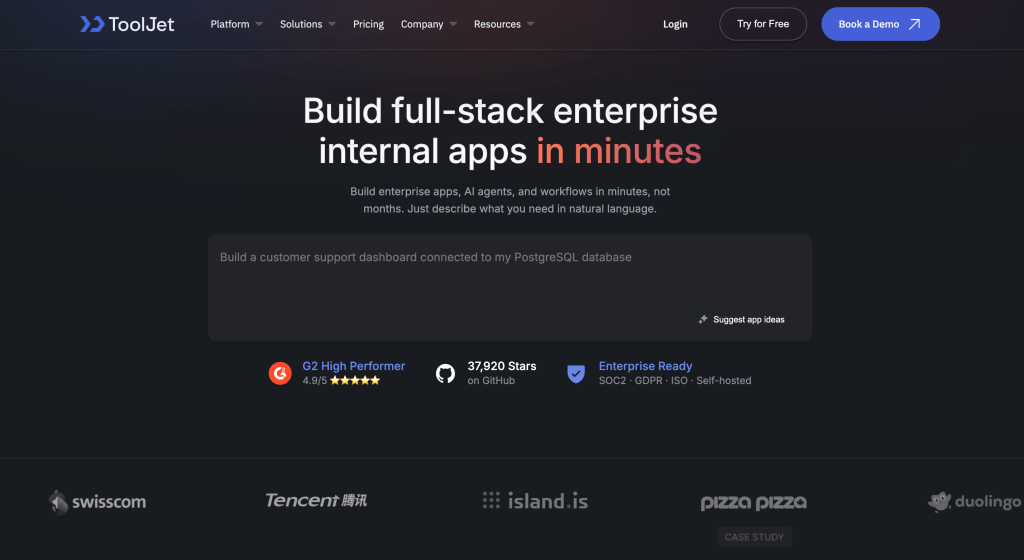
Open-Source and Self-Hostable
ToolJet is open-source (AGPL licensed) and can be deployed on your own infrastructure: AWS, GCP, Azure, Kubernetes, Docker, Heroku, or any VPS. This is a fundamental architectural difference from WeWeb. For companies in healthcare, banking, government, or any environment where data sovereignty is non-negotiable, ToolJet is often the only serious option on the shortlist.
A Drag-and-Drop Builder That Actually Understands Internal Tools
WeWeb’s builder was designed for public-facing websites. ToolJet’s was designed for internal apps. That distinction matters more than it sounds. ToolJet ships with 100+ pre-built UI components purpose-built for operational use: data tables with inline editing, Kanban boards, calendar views, multi-step forms, charts, PDF viewers, and more. You can build a fully functional admin panel in a few hours, not days.
Deep, Native Integrations Beyond REST APIs
ToolJet being the only open source WeWeb alternative connects natively to 100+ data sources out of the box: PostgreSQL, MySQL, MongoDB, Snowflake, BigQuery, Airtable, Stripe, Salesforce, HubSpot, GitHub, Twilio, OpenAI, and dozens more. Not via a third-party connector layer, but natively, with a visual query builder that handles joins, filters, and transformations without writing SQL.
JavaScript Where It Matters
ToolJet’s philosophy is no-code first, code when you need it. Every component, query, and event handler can be extended with JavaScript. You can write custom transformations, chain queries, build conditional logic, and even create reusable component libraries, all without leaving the builder. This is a meaningful upgrade over WeWeb’s more frontend-constrained model.
Workflow Automation Built In
ToolJet being a self-hosted no-code platform includes a visual workflow builder for multi-step automations. Think Zapier-style logic, but native to your app and your data. Trigger workflows from form submissions, table edits, button clicks, or scheduled intervals. This is something WeWeb simply doesn’t offer at the same depth.
Collaboration and Role-Based Access
ToolJet being the best Bubble alternative for internal tools supports granular RBAC, allowing you to define exactly who can view, edit, or manage specific apps and resources. For enterprise deployments, especially those with multiple teams using the same ToolJet instance, this is essential.
Where ToolJet falls short: If you’re building a polished, consumer-facing marketing site or a storefront, ToolJet isn’t your tool. It’s purpose-built for internal and operational apps. For that use case, WeWeb or Webflow is genuinely better.
The verdict: For internal tools, data apps, and anything requiring self-hosting or compliance, ToolJet is the clear number-one WeWeb alternative.
Try ToolJet free, no credit card required
2. Superblocks: Best Developer-First Internal Tool Builder
Best for: Engineering teams that want to build internal tools with real code and real integrations
Pricing: Free for small teams | Team from $49/month | Business and Enterprise custom

Superblocks occupies an interesting position in this space. It’s built for developers first, with a philosophy that internal tools shouldn’t require you to compromise on how you write logic. You get a visual canvas for layout, but JavaScript and Python are first-class citizens throughout, not afterthoughts bolted on for edge cases.
The integration story is strong. Superblocks connects to most major databases and APIs natively, and its support for scheduled jobs and triggered automations makes it a reasonable choice for teams that need their internal tools to do more than just display data.
Where Superblocks loses ground to ToolJet is on openness and cost. There’s no open-source version, self-hosting is available only on enterprise contracts, and the pricing jumps meaningfully once you move past the free tier. For teams that prioritize code-first ergonomics and don’t have compliance-driven hosting requirements, it’s a credible option. For everyone else, ToolJet covers the same ground with more flexibility.
Best if: Your team is developer-heavy, you want Python support alongside JavaScript, and self-hosting isn’t a requirement.
3. Softr: Best for Client Portals and Non-Technical Teams
Best for: Operations and business teams building portals, directories, and lightweight apps on top of Airtable or Google Sheets
Pricing: Free | Basic from $49/month | Professional from $99/month | Business from $179/month

Softr takes a different approach from most tools on this list. Instead of connecting to a broad set of data sources, it’s built tightly around Airtable and Google Sheets, turning those spreadsheets into functional web apps without any code at all. Customer portals, member directories, job boards, event listings, and simple approval flows are all achievable in a matter of hours.
For the right use case, Softr is genuinely impressive. A non-technical ops manager can build and launch a client-facing portal in a day, which is a meaningful business outcome.
The limitations become apparent quickly once you push beyond the basics. Complex relational data, multi-step workflows, API integrations, and any meaningful custom logic all hit walls that Softr isn’t designed to clear. It also has no self-hosting option and no open-source model. For teams that have already outgrown spreadsheets as a data layer, the foundation doesn’t hold.
ToolJet is a better fit the moment your data source isn’t Airtable, your logic is more than a few conditions deep, or your stakeholders have compliance requirements.
Best if: Your data lives in Airtable or Google Sheets, your team is non-technical, and you need a polished portal or directory fast.
4. Budibase: Best for CRUD apps
Best for: Teams that want to build CRUD apps around internal data quickly
Pricing: Free | Premium from $50/month | Enterprise custom

Budibase is a low-code platform with a strong emphasis on data management. It has its own internal database (Budibase DB), which makes it incredibly fast to spin up simple data entry apps, approval flows, and reporting dashboards without connecting an external database first.
Compared to WeWeb, Budibase is less design-forward. You’re not going to build a beautiful consumer-facing app here. But for an internal HR portal, a vendor management dashboard, or a ticketing system, it punches above its weight.
Budibase is also open-source and self-hostable, which puts it in the same compliance-friendly category as ToolJet. However, it lacks the breadth of integrations and the workflow automation depth that ToolJet offers.
Best if: You want a simple, fast path to a CRUD app and don’t need heavy customization.
5. Webflow: Best for Marketing and Consumer-Facing Sites
Best for: Designers and marketers building public-facing websites
Pricing: Free | Basic from $14/month | CMS from $23/month | Business from $39/month
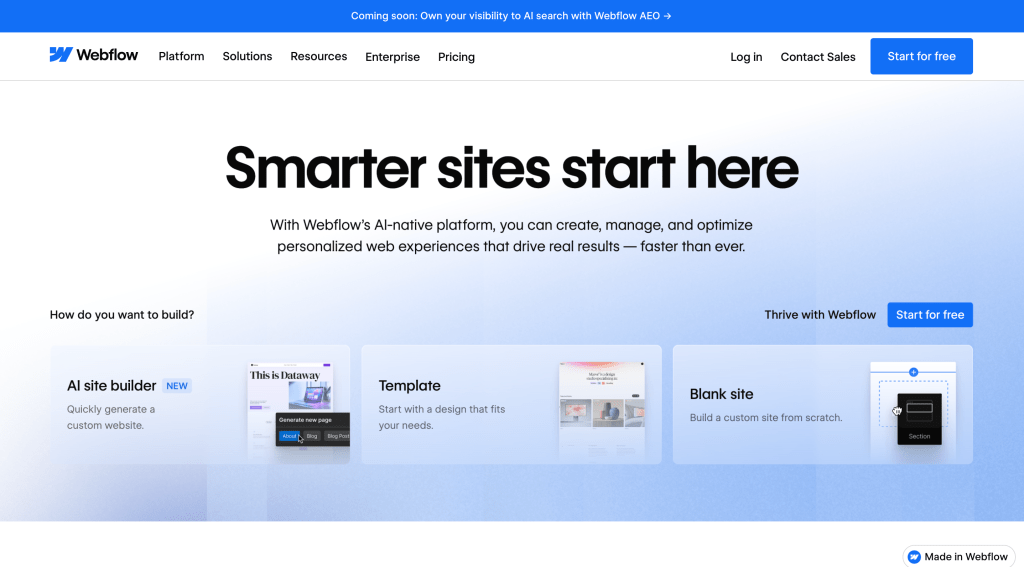
If WeWeb’s visual builder is what you love, Webflow offers more of that, better in many respects. It’s the gold standard for no-code visual web design: pixel-perfect layouts, responsive breakpoints, CMS-driven content, animations, and a massive ecosystem of templates and integrations.
The key distinction: Webflow is a website builder, not an app builder. It doesn’t connect natively to databases like Postgres or APIs like Stripe without third-party glue. It has no real component logic layer. And it isn’t suitable for internal tools at all.
If you’re building a landing page, blog, portfolio, or marketing site and found WeWeb limiting for that use case, Webflow is the answer. If you’re building an app, keep reading.
Best if: You’re building a content-heavy public site and want the most design flexibility possible.
6. Bubble: Most Powerful No-Code App Builder
Best for: Building fully-featured SaaS products without writing code
Pricing: Free | Starter from $29/month | Growth from $119/month | Team from $349/month
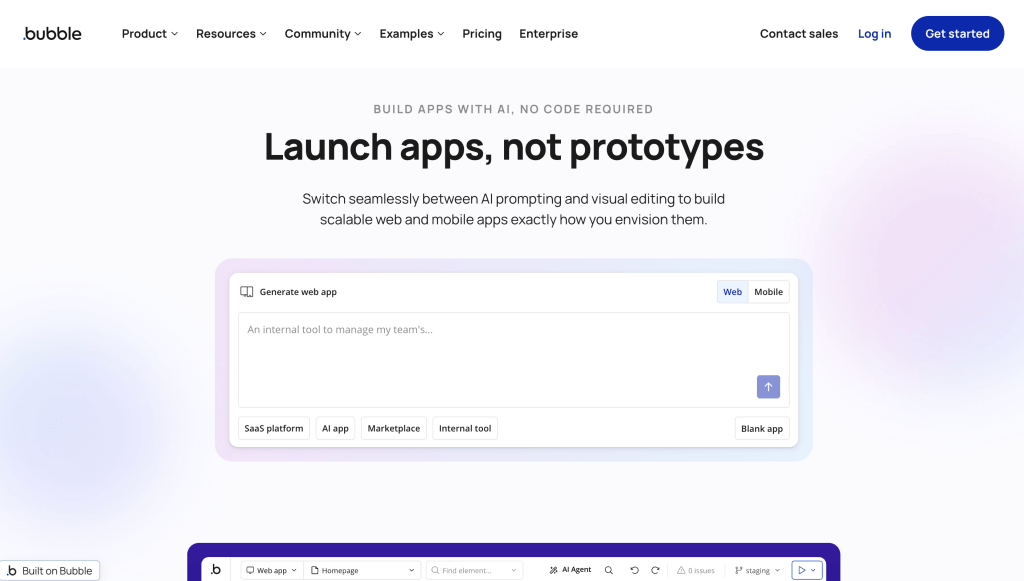
Bubble sits at the heavier end of the no-code spectrum. It allows you to build genuinely complex, multi-sided applications (think Airbnb-style marketplaces, SaaS dashboards, or social platforms) entirely without code. It handles its own database, user authentication, workflows, and frontend all in one.
The tradeoff: Bubble has a steep learning curve. Its editor is complex, its performance can lag on heavy apps, and its platform-specific abstractions mean that knowledge doesn’t transfer neatly to other tools.
For teams building an internal tool or operations app, Bubble is overkill in the wrong direction. You’d spend months learning the platform for something ToolJet could produce in a week.
Best if: You’re building a consumer product, not an internal tool, and want to avoid writing backend code entirely.
7. Glide: Best for Simple Mobile Apps
Best for: Non-technical teams building lightweight mobile or tablet apps
Pricing: Free | Maker from $49/month | Team from $99/month | Business from $249/month
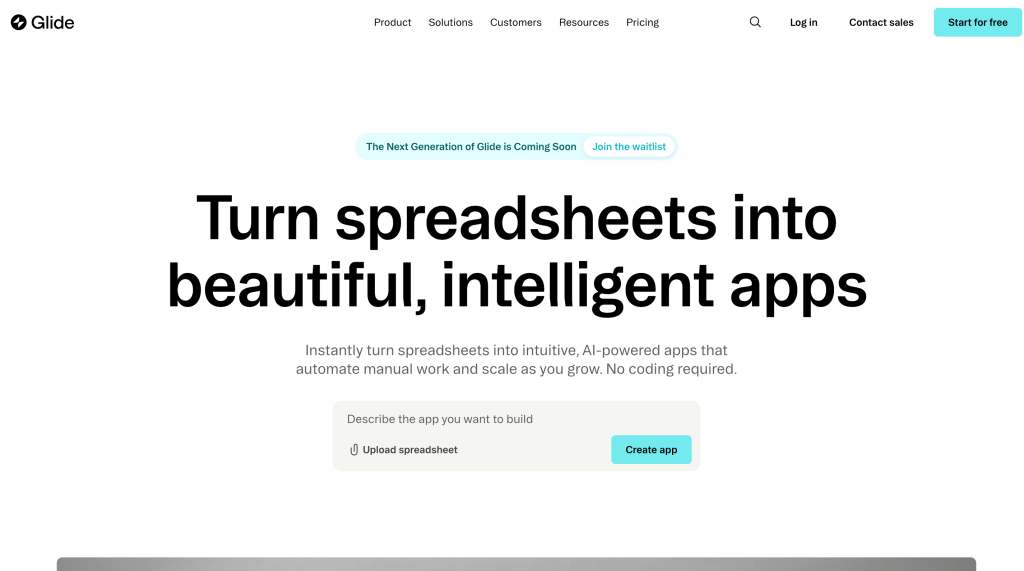
Glide turns spreadsheets and simple data sources into functional mobile apps with almost no configuration. It’s genuinely impressive for what it is: a fast path to a field service app, a customer portal, a directory, or a simple workflow, especially if the audience is non-technical.
Where Glide breaks down: it doesn’t scale. Complex logic, heavy data volumes, custom integrations, and granular RBAC all require workarounds or simply aren’t possible. It sits at the opposite end of the spectrum from ToolJet. Great for simple, fast, and lightweight use cases; not suited to serious operational tooling.
Best if: You need a quick mobile app for a field team or a simple directory or form app, and you’re not a developer.
8. DronaHQ: Good WeWeb Alternative for Enterprise
Best for: Small teams with existing tool stacks
Pricing: Free tier | Starter from $10/user/month | Business from $20/user/month | Enterprise custom
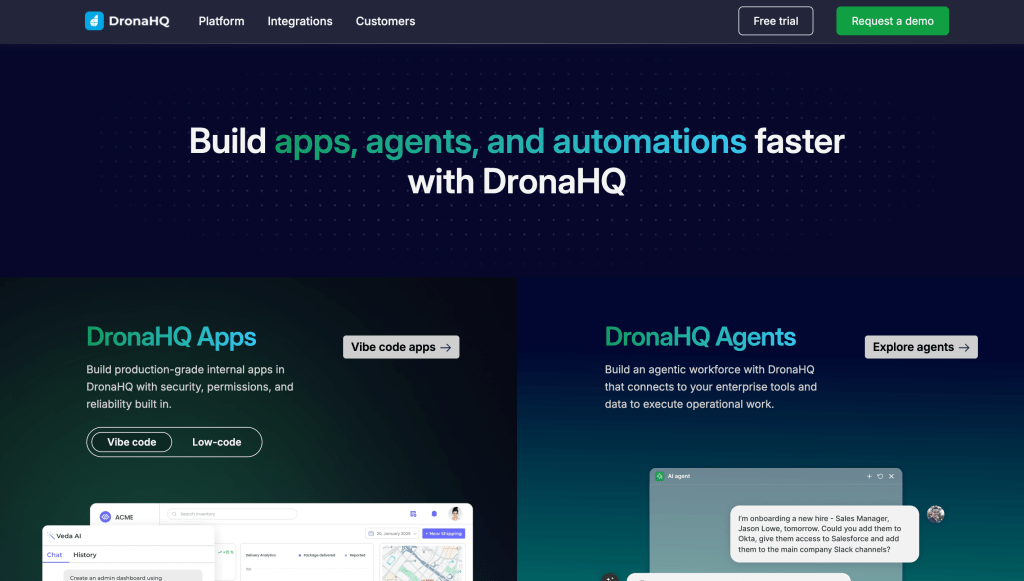
DronaHQ is a low-code platform with a strong enterprise story: SSO, audit logs, custom branding, and a solid set of native integrations with enterprise tools like SAP, Salesforce, and ServiceNow. It covers similar ground to ToolJet on paper and is a legitimate name to include in enterprise procurement evaluations.
Where it falls behind: the platform isn’t open-source, the development roadmap isn’t public-facing, and pricing becomes harder to forecast at higher tiers. Teams that want the transparency and community momentum of an open-source platform will find ToolJet a more comfortable long-term bet.
Best if: You’re an enterprise procurement team running a formal vendor evaluation and want a well-documented alternative alongside ToolJet.
9. UI Bakery: Lightweight Internal Tool Builder
Best for: Small teams that want a quick, clean internal tool builder
Pricing: Free (limited) | Pro from $30/month | Business from $60/month

UI Bakery is a newer entrant in the internal tool space. Its interface is clean, it supports Angular under the hood (which is unusual and appealing for teams with an Angular background), and it has a sensible set of integrations.
It doesn’t yet match ToolJet in terms of component depth, workflow automation, or community support, but it’s worth watching. For smaller teams with simpler needs, it can be a lower-friction starting point.
Best if: You have a small team, simple use cases, and want a lightweight cloud-hosted internal tool builder.
Head-to-Head Comparison: ToolJet vs WeWeb vs Top Alternatives
| Feature | ToolJet | WeWeb | Superblocks | Softr | Budibase |
|---|---|---|---|---|---|
| Open Source | Yes | No | No | No | Yes |
| Self-Hostable | Yes, always free | No | Enterprise only | No | Yes |
| Internal Tool Focus | Purpose-built – Yes | Frontend-first | Yes | Partial | Yes |
| Native DB Integrations | Yes, 100+ | Via REST/plugins | Yes | Airtable/Sheets only | Yes |
| Workflow Automation | Yes | No | Yes | Limited | Limited |
| Custom JavaScript | Yes | Yes | Yes | No | Partial |
| RBAC | Yes | Basic | Yes | Basic | Yes |
| Mobile Responsive | Yes | Yes | Partial | Yes | Yes |
| Free Plan | Yes | Yes, limited | Yes, limited | Yes | Yes |
| Starting Price | $19/user/mo | $49/mo | $49/mo | $49/mo | $50/mo |
| Consumer-Facing Apps | Not the focus | Excellent | Not the focus | Partial | Not the focus |
How to Choose the Right WeWeb Alternative?
The right answer depends on what you’re building and who’s building it.
Choose ToolJet if:
- You’re building internal tools, admin panels, ops dashboards, or data apps
- Data compliance, self-hosting, or SOC 2 / HIPAA alignment matters to your team
- You want open-source flexibility with a commercial support option
- You need native integrations with databases, APIs, and SaaS tools
- You want workflow automation without adding another tool to your stack
- You’re a developer or technical team that wants to move fast without full-custom development
Choose Superblocks if:
- Your team writes code and wants Python support alongside JavaScript
- You need strong scheduled job and automation capabilities
- Self-hosting and open-source licensing aren’t requirements
Choose Softr if:
- Your data already lives in Airtable or Google Sheets
- You need a client portal or member directory, not a complex internal app
- The person building it is non-technical and needs something fast
Choose Webflow if:
- You’re building a consumer-facing website, landing pages, or a content-driven site
- Design fidelity and animation quality are paramount
- You don’t need database connectivity or app-level logic
Choose Bubble if:
- You’re building a consumer SaaS product from scratch
- You don’t want to manage any infrastructure
- You’re willing to invest time learning the platform’s model
Stick with WeWeb if:
- You’re building a visually rich, consumer-facing web application
- Your team is design-led and doesn’t have backend complexity
- You’re happy with the pricing and don’t need self-hosting
Why ToolJet Is the Best WeWeb Alternative for Most Teams?
We’ve tried to be fair throughout this article, and we genuinely believe WeWeb, ToolJet, Webflow, Bubble, and others are excellent tools for specific use cases.
But if we’re being direct about where WeWeb’s gaps are most commonly felt, and where ToolJet fills them most completely:
1. Self-hosting and data sovereignty. ToolJet is one of the only full-featured app builders that is open-source, freely self-hostable, and enterprise-ready at the same time. For teams in regulated industries, this isn’t a nice-to-have; it’s a requirement.
2. Internal tool depth. WeWeb was built to create beautiful frontends. ToolJet was built to make internal tools. The component library, the query system, and the workflow automation engine are all oriented around operational use cases.
3. Cost efficiency at scale. ToolJet’s open-source tier is genuinely unlimited. The paid plans scale more predictably than most alternatives. For a 10 to 50 person team building multiple internal apps, the cost difference is often significant.
4. Developer ergonomics. ToolJet doesn’t ask developers to give anything up. You can write JavaScript everywhere, build reusable components, manage version control, and deploy to your own infrastructure. It’s a no-code builder with a developer-grade foundation.
5. Everything in one place. With ToolJet’s built-in workflow automation, you can replace Zapier and Make integrations that WeWeb typically requires for backend logic. Fewer tools, fewer failure points, lower monthly costs.
The Bottom Line
WeWeb is a good tool. If it’s working for you, there’s no need to change. But if you’re hitting the ceiling on pricing, compliance, internal tool functionality, or backend power, there are better options.
ToolJet is the most complete, the most flexible, and the most cost-effective WeWeb alternative for teams building internal tools and operational apps. It’s open-source, self-hostable, deeply integrated, and designed from the ground up for exactly the use cases where WeWeb shows its limits.
The best way to evaluate it is to try it.
Get started with ToolJet for free
See ToolJet templates and use cases
Read the ToolJet documentation