Mendix and ToolJet address overlapping enterprise application needs with different development models. Mendix uses model-driven application development for a broad app estate; ToolJet focuses on internal applications over existing databases and APIs, combining AI generation, visual editing and JavaScript/Python logic.
This comparison is for teams choosing between these two platforms. For a multi-vendor shortlist, use our Mendix alternatives guide. The recommendations below are editorial fit assessments, not a measured performance or security ranking. Product scope was checked against linked sources on October 5, 2026.
Quick Overview
| Requirement | Mendix | ToolJet |
|---|---|---|
| App focus | Broader model-driven enterprise applications | Internal dashboards, operations interfaces and business apps over existing data |
| Development approach | Visual application models and extensibility | AI generation, visual editing and JavaScript/Python logic |
| Platform hosting | Review the selected Mendix deployment and runtime | Managed Cloud or Self-hosted from Free |
| Source access | Confirm the scope of platform, SDK and app artifacts | AGPL-3.0 Community Edition; licensed governance/deployment capabilities |
| AI boundary | Confirm configuration and dependencies for each AI feature | Managed AI, or Enterprise BYOK on Cloud or Self-hosted, or the Self-hosted Enterprise customer-hosted gateway add-on |
| Mobile requirements | Evaluate the required native/offline app model | Validate responsive internal-app requirements; do not assume native/offline parity |
| Cost model | Edition, apps, users, hosting and support terms | Builder licensing, plan allowances, AI usage, add-ons and hosting operations |
About Mendix
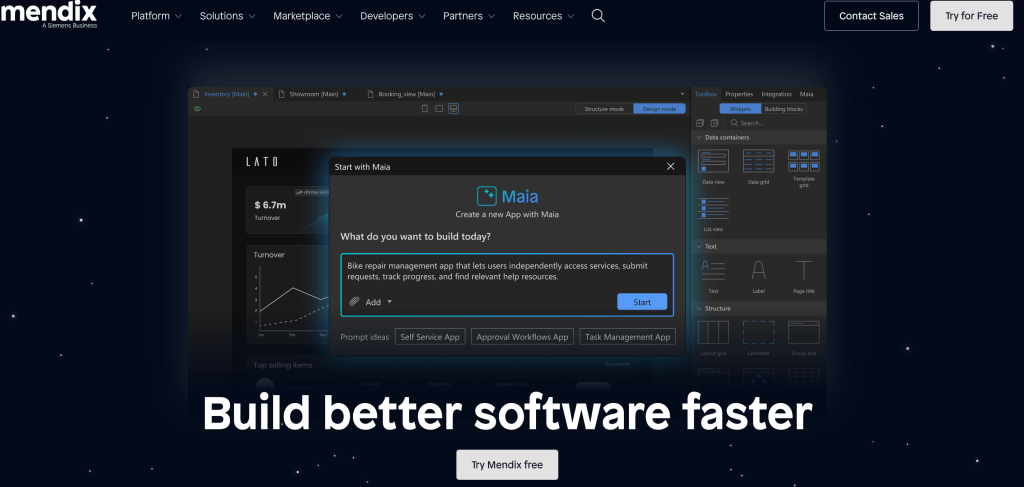
Mendix describes application development, process orchestration and AI governance in its platform overview. It is relevant when the program includes a broader set of enterprise applications, model-driven logic and web/mobile requirements.
Start from the existing domain model, microflows, widgets and integrations. Evaluate the selected runtime using deployment documentation, including operating services and responsibilities. A familiar visual editor does not mean an application can be moved unchanged into another platform.
About ToolJet
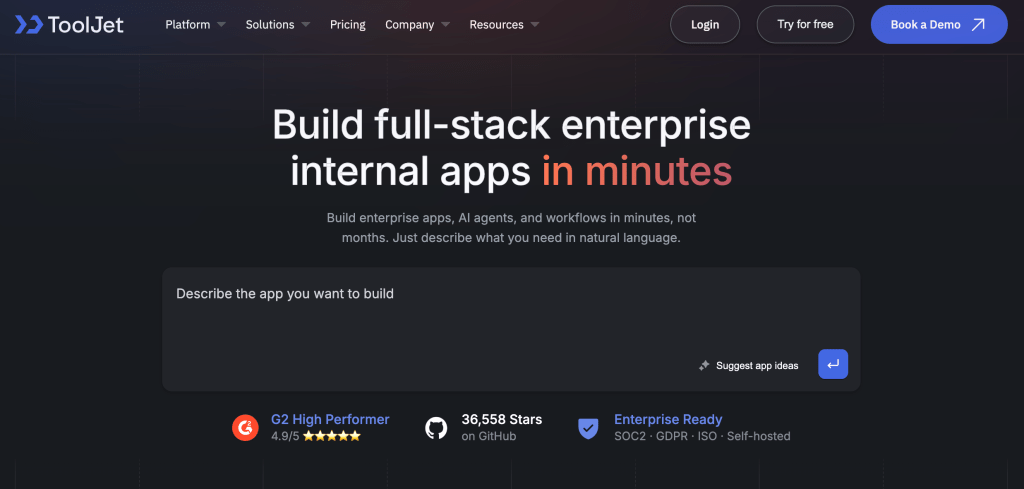
ToolJet combines AI-assisted app generation, a visual builder, database/API queries and custom logic for internal applications. It offers 100+ integrations and an open-source Community Edition that can run on customer infrastructure.
Team includes SSO, audit logs and Git sync. Enterprise adds SCIM and multiple Self-hosted deployments. Workflows, Agent Builder and private/custom connectors are Self-hosted-only. Review the current feature tables for exact availability, app environments and user allowances.
Development and Application Architecture
For an operations console, prototype the difficult query, permission-sensitive action and custom screen first. ToolJet allows teams to work directly with existing data sources and refine generated apps visually or with code. A Mendix evaluation should test the model, logic and integration approach your team plans to maintain.
Compare both the initial build and a later change: a new approval state, a modified database schema or an additional user role. Include testing and review time, not just prompt-to-preview time. ToolJet’s coding-agent plugin and MCP tools provide another way to create and maintain native ToolJet apps through a coding agent.
Governance, Identity and Releases
Agree who may create apps, alter credentials, approve releases and access audit evidence. Test least-privilege roles and user removal in the specific edition. Evaluate permission boundaries in generated queries as well as visible UI components; hiding a button does not establish server-side authorization.
ToolJet Enterprise customers can run separate Self-hosted development, staging and production deployments and promote app definitions with GitSync. Configure secrets and data sources separately. Review the security architecture and Trust Center for assurance information and operating responsibilities.
AI Providers, Gateway Hosting and Data Boundaries
Separate the location of the app platform, AI gateway and inference endpoint. For both products, document the data each AI feature can access, where requests and logs are stored, and which services remain external. Test the proposed configuration with sanitized data before connecting sensitive sources.
ToolJet managed AI supports provider selection. Its model-selection documentation distinguishes that from selecting a compatible exact model through OpenRouter BYOK. Enterprise BYOK is available on both ToolJet Cloud and Self-hosted deployments. A customer-hosted AI gateway is a Self-hosted Enterprise add-on. Running inference internally also requires a supported model endpoint inside your network.
An external model provider still receives requests under BYOK. ToolJet’s AI data policy explains that connected credentials can expose available data during discovery. Limit those credentials, review generated queries and protect logs containing prompts or responses.
Deployment and Offline Requirements
Self-hosting is an operating model, not a guarantee that every dependency is internal. Inventory databases, identity, email, Git services, telemetry, model endpoints and licensing requirements. Assign responsibility for patches, backups, restoration and support access.
ToolJet supports fully offline platform operation and licensing with the Self-hosted Enterprise air-gapped add-on. AI inside that boundary additionally needs a local gateway and supported local endpoint. Teams can enable AI only in development and disable it in other deployments; apps using AI at runtime still need the relevant service or must remove that feature.
For Mendix, specify the exact deployment and contracted services, then test the required boundary against its documentation. The choice should come from a validated architecture rather than a generic “Cloud versus on-premises” checkbox.
Mobile and Workflow Requirements
If native mobile, offline synchronization or device-specific behavior is central, test those tasks explicitly in the shortlist. Responsive internal web apps and native/offline applications are different requirements. Mendix’s broader mobile application scope should be evaluated against the actual device and data model.
Likewise, a transaction dashboard and a long-running case-management system have different orchestration needs. ToolJet Workflows and Agent Builder run on Self-hosted. Validate triggers, error handling, retries and approvals for your process before treating either platform as a replacement for an existing workflow engine.
Pricing and Total Cost of Ownership
Use current Mendix pricing and ToolJet pricing for the edition and rollout you plan to buy. Older per-app ToolJet prices and mixed-currency Mendix figures are not a reliable procurement comparison.
ToolJet prices builder seats and includes end-user allowances by plan, with unlimited end users on Enterprise. Free includes 2 builders, 50 end users, 10 apps and unlimited pages. Add required governance, deployment and AI options to the quote, together with infrastructure and operations for Self-hosted.
- Count builders, internal viewers and external users separately.
- Specify apps, environments, hosting, support and required service commitments.
- Include AI credits/provider usage, gateway hosting and deployment add-ons.
- Estimate rebuilding, testing and rollout of the existing application.
- Model ongoing upgrades, incident response and recovery work.
Team Enablement and Support
A production rollout needs maintainers beyond the original builder. ToolJet offers Academy courses and certifications; Mendix also provides an Academy. Review the skills, documentation and onboarding work your team will need.
Confirm support coverage, escalation contacts and recovery responsibilities in the selected contract. A training certificate, community forum or generic support claim should not be substituted for the operational commitments needed by a critical application.
What to Choose
Shortlist ToolJet when your primary requirement is governed internal apps over existing data, with AI-assisted building, custom code and control over platform deployment. Shortlist Mendix when the program needs a broader model-driven application estate and mobile or lifecycle requirements that your pilot validates.
Choose one representative application and compare the hardest integration, permission boundary, release and recovery task. Record the architecture, full costs and ongoing ownership. If ToolJet fits, use a deployment demo to review infrastructure, approved models and required Enterprise add-ons.
Frequently Asked Questions
Mendix provides broader model-driven application development. ToolJet focuses on internal applications over existing data, combining AI generation, visual editing, custom logic and open-source self-hosting. Evaluate both against the actual workload.
Self-hosted Enterprise offers a customer-hosted AI gateway add-on. Enterprise BYOK is available on both ToolJet Cloud and Self-hosted deployments. Internal inference requires a supported model endpoint inside your infrastructure. BYOK to an external provider still sends requests externally.
Yes, with the Self-hosted Enterprise air-gapped add-on, including offline licensing. Keep required services internal, and use a local gateway and supported local endpoint if AI is enabled.
No. ToolJet’s Community Edition provides platform source access and self-hosting, while app definitions remain ToolJet-specific. A migration still requires evaluating exports, logic rebuilding, interfaces and testing.
No. Free includes unlimited pages, with separate allowances for builders, end users and apps. Check current pricing for AI credits and plan-specific governance.
Use the dedicated Mendix alternatives guide for a multi-vendor shortlist. This page focuses on the two-platform decision.