The Forrester Wave is a vendor evaluation, not a market-size forecast. For buyers comparing low-code platforms in 2026, the verified edition discussed here is Low-Code Platforms For Professional Developers, Q2 2025, published May 8, 2025. Its public summary covers 13 providers.
This guide separates the report from Forrester’s market forecast and adds ToolJet’s own evaluation questions. It does not reproduce the paid scorecard or claim that Forrester evaluated or endorsed ToolJet.
Start with your application’s users, data sources, deployment requirements and operating budget. Use analyst research to inform a shortlist, then test each product against the same requirements.
The growing demand for low-code platforms
1. The $30 billion forecast and $50 billion scenario are different
Forrester’s January 2024 forecast projected approximately $30 billion for the combined low-code and digital process automation market in 2028 at 21% annual growth. A separate AI-driven upside scenario approached $50 billion at 33% growth. Neither figure is a measured 2026 market size or a conclusion of the 2025 Wave.
What this means for a buying decision
- Institutionalization in IT
Category adoption does not prove suitability for your application. Ask vendors for references with comparable security requirements and operating scale.
- Citizen development
Decide which changes business users may make themselves, which require a builder, and which need technical review before release.
- Economic pressures
Compare total operating cost, including builders, end users, environments, infrastructure, support, integrations and AI consumption.
- Technological advancements
Test AI on a maintenance task as well as an initial build. The result must remain understandable, editable and compatible with your permissions and release process.
2. How to use the Forrester Wave methodology
Forrester’s published methodology describes a structured vendor comparison with defined criteria, vendor input and reference research. Consult the full report for its scores and findings. The questions below are our own buying guidance.
- Read the market definition and report date
Check whether the evaluation covers professional developers, business users or another audience. A platform suited to one group may require skills that another group does not have.
- Separate available features from roadmap promises
Record whether each requirement is available in the plan and deployment you would buy. Confirm limitations in documentation and a demonstration using your own scenario.
- Validate your shortlist with a proof of concept
Build a representative application, change its data model, test unauthorized access and promote a reviewed version between environments. Record implementation effort and unresolved dependencies.
Also, read our blog on “Top No-code Builders of 2026, and Top low-code internal builders of 2026“.
3. Compare platforms against the same requirements
An employee portal, a case-management application and a database administration tool can require different capabilities. Define the job before comparing products.
Use a weighted evaluation checklist
List mandatory requirements first: identity, server-side authorization, connectivity, deployment and recovery. Then score usability, maintainability and cost. A high overall score should not compensate for a failed security requirement.
4. The role of AI in low-code development
AI generation changes how an application is started. It does not remove the need to review queries, permissions, validation, error handling and release controls.
- Give each platform the same prompt and sample data. Record model, elapsed time, human interventions and USD-equivalent usage cost.
- Test a follow-up edit and verify the result. A single run is not a guaranteed production cost.
Also, read our blog on “Building generative AI-powered apps: a hands-on guide for developers.”
Organizational strategies in low-code adoption
Assign an owner to each application and define who may change it. Document how access, releases and incidents will be reviewed.
Three outcomes to measure during the pilot
- Time to complete a working application and a subsequent change.
- Correct behavior for authorized and unauthorized users, including failed requests.
- The cost and effort of operating, supporting and maintaining the application.
Validate ROI instead of assuming it
Compare the pilot with your current process using engineering hours, request turnaround, support effort and recurring costs. Results depend on application complexity, licensing and the team operating it.
Curious which low-code platforms are leading the pack in 2026? Discover our latest blog’s Top 10 Low-code Internal Tool builders reshaping how teams build software.
Platform evaluation questions beyond the report
1. OutSystems

For an OutSystems evaluation, start with the product edition and deployment proposed by the vendor. Use a representative application to establish what your team can build and maintain.
Ask for a breakdown of licensing, environments, capacity and support. Confirm how AI-generated changes enter review and release processes.
Test integration failures, mobile layouts and rollback. Request evidence for performance and availability commitments relevant to your workload.
2. Mendix
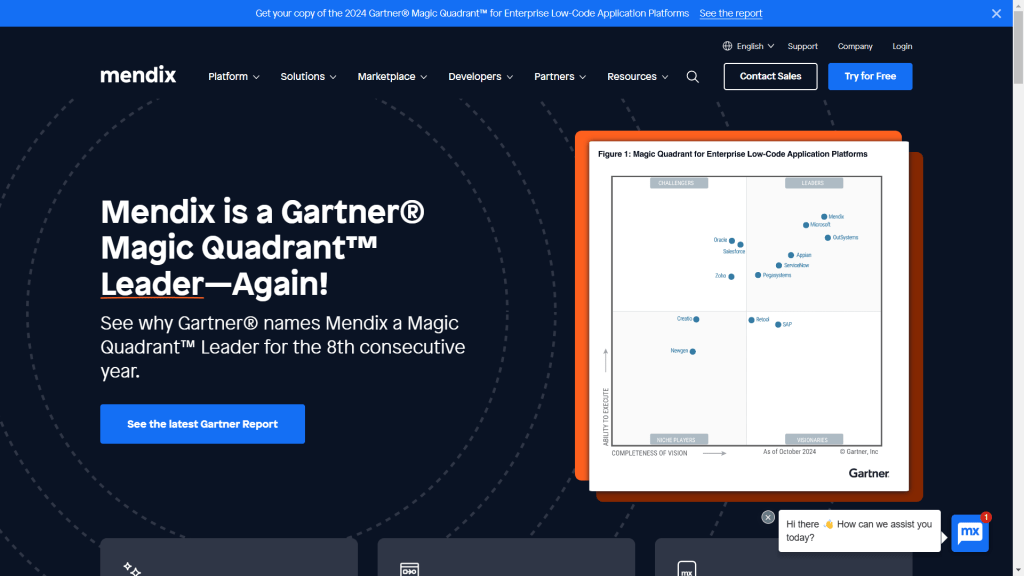
For a Mendix evaluation, include a routine visual change and a change requiring custom logic. Have the people who will maintain the application perform both.
Confirm deployment, identity integrations and environment controls in the quoted plan. Identify dependencies on extensions, external services and additional licenses.
Test collaboration, data access boundaries and promotion between environments. Document export options and maintenance of custom extensions.
3. Appian

For an Appian evaluation, use a representative case or approval process with exceptions, reassignment and restricted information. Evaluate the complete process rather than only the initial form.
Ask how integrations, execution, storage and support affect the quote. Have the intended administrators demonstrate a safe change and recovery from a failed integration.
4. Oracle APEX
For an Oracle APEX evaluation, confirm the Oracle Database and hosting arrangement required by the proposed application. Assess application and database operating costs together.
Test the SQL and PL/SQL skills required for your use case, alongside UI maintenance, authentication and deployment. Demonstrate the versioning and release approach.
Use your actual data architecture to assess fit. Confirm infrastructure dependencies and operating responsibilities rather than assuming that a development feature removes them.
ToolJet: An Enterprise Grade Low code platform

ToolJet is another option to evaluate for internal applications. This section is our own product guidance, not a Forrester ranking or endorsement.
Start with an approval workspace or operations dashboard. Test data queries, user roles, validation and the follow-up edits your team will maintain.

ToolJet combines AI app generation and a visual builder with database and API integrations. Evaluate it using actual data sources and permission requirements.
Review security and governance and self-hosted deployment options. Confirm which controls and add-ons are included before choosing an architecture.
Bring-your-own LLM keys is an Enterprise add-on for Cloud and Self-Hosted. Customer-hosted AI gateways and fully air-gapped operation require the relevant enterprise add-ons. Workflows are available on Self-Hosted; confirm deployment fit before including workflow automation in a Cloud evaluation.
Use the current pricing tables for plan scope. Request a quote separating builders, deployment, AI usage and optional services to compare costs on the same assumptions.
Important links
- Community: ToolJet community
- GitHub: ToolJet source repository
- Docs: ToolJet documentation