What is AI Engineering?
AI engineering is the practice of building, evaluating, deploying and maintaining software systems that use AI models. It includes data pipelines, model selection or training, application integration, testing and production monitoring. Many projects adapt an existing model rather than train one from scratch; reliable behavior, access control, latency and cost matter alongside model quality.
Everyday Examples of AI Engineering
- Navigation: predictive models can estimate journey times from traffic and historical data. Engineers evaluate accuracy across routes and changing conditions.
- Recommendations: models rank content or products using relevant signals. Evaluation should include usefulness, diversity and the effect of feedback loops.
- Support assistants: language models can answer questions using approved information. Retrieval permissions, source attribution and a fallback are important; a chatbot does not automatically retrain itself after each conversation.
- Voice interfaces: speech recognition and language processing can convert spoken requests into actions. Confirm intent and authorization before consequential actions.
- Anomaly detection: models can flag unusual activity for investigation. Engineers monitor false positives and changing data distributions rather than assuming accuracy improves automatically.
Importance of AI Engineering in Modern Technology
AI engineering plays a pivotal role in shaping modern technology. By enabling the development of intelligent systems, it can analyze vast amounts of data and make real-time decisions. AI engineering improves business outcomes and fosters competitive advantages in a rapidly evolving market.
- Data Processing: AI systems can analyze massive datasets and provide real-time insights.
- Industry Transformation: Healthcare, finance, and transportation fields leverage AI to enhance operations.
- Personalization: AI creates customized experiences, improving customer satisfaction and business outcomes.
AI is useful when it improves a defined task. Establish a non-AI baseline, decide what counts as a correct result and measure failure cases as well as average performance. Some tasks are better served by deterministic rules or a conventional database query.
It prompts organizations to invest significantly in this field, making AI engineers an indispensable resource for growth. As AI continues to reshape industries, it opens exciting opportunities for professionals aspiring to excel in this dynamic and futuristic domain.
AI Engineer Roles and Responsibilities

Key Skills and Qualifications for AI Engineers
AI engineering is a field that requires a diverse skill set to design and implement intelligent systems. Here are the core skills and qualifications that aspiring AI engineers should possess:
- Programming and software engineering: learn Python, testing, Git, APIs and SQL. Additional languages depend on the application and runtime; every role does not require Python, Java and C++ together.
- Data and evaluation: understand data quality, training/validation/test splits, leakage, class imbalance and task-specific metrics.
- Models: understand when to use an existing model, retrieval, fine-tuning or training. CNNs, RNNs and transformers are model architectures, not basic data structures.
- Mathematics: build foundations in linear algebra, probability, statistics and optimization appropriate to your work.
- Application security: protect secrets, enforce data permissions and treat model-generated output as untrusted input.
- Deployment: learn service monitoring, timeouts, retries, versioning, rollback and resource costs. Containers and orchestration are useful when the deployment requires them.
Typical Tasks and Projects for AI Engineers

AI engineers work on projects that develop and integrate AI capabilities into real-world applications. Some of their key responsibilities include:
- Developing and Deploying Machine Learning Models:
AI engineers design, train, and deploy machine learning models to solve problems such as predictive analytics, image recognition, and natural language understanding. They optimize these models for accuracy, efficiency, and scalability. - Designing and Implementing Data Pipelines:
In collaboration with data scientists, AI engineers build robust data pipelines to collect, preprocess, and transform raw data into formats suitable for machine learning. These pipelines are essential for maintaining a seamless data flow in AI-driven applications. - Integrating AI Models into Larger Systems:
AI engineers work closely with software developers to embed AI models into broader software ecosystems. This involves creating APIs, ensuring compatibility, and maintaining system reliability during integration. - Continuous Model Improvement:
AI engineers regularly monitor and refine deployed models based on new data or changing requirements, ensuring that AI solutions remain relevant and effective over time. Engineers also rely on AI agent evaluation to continuously assess model performance and identify areas for improvement.
Collaboration with Other Teams and Stakeholders
Collaboration is a cornerstone of AI engineering. AI engineers must work closely with various teams and stakeholders to ensure successful project outcomes:
- Data scientists and domain experts: agree on the problem, data quality, evaluation criteria and interpretation of errors.
- Software and platform teams: agree on API contracts, authentication, deployment ownership and incident response.
- Business stakeholders: define acceptance criteria and the human fallback. Document what the system cannot safely decide or automate.
AI Engineering: Focus Areas
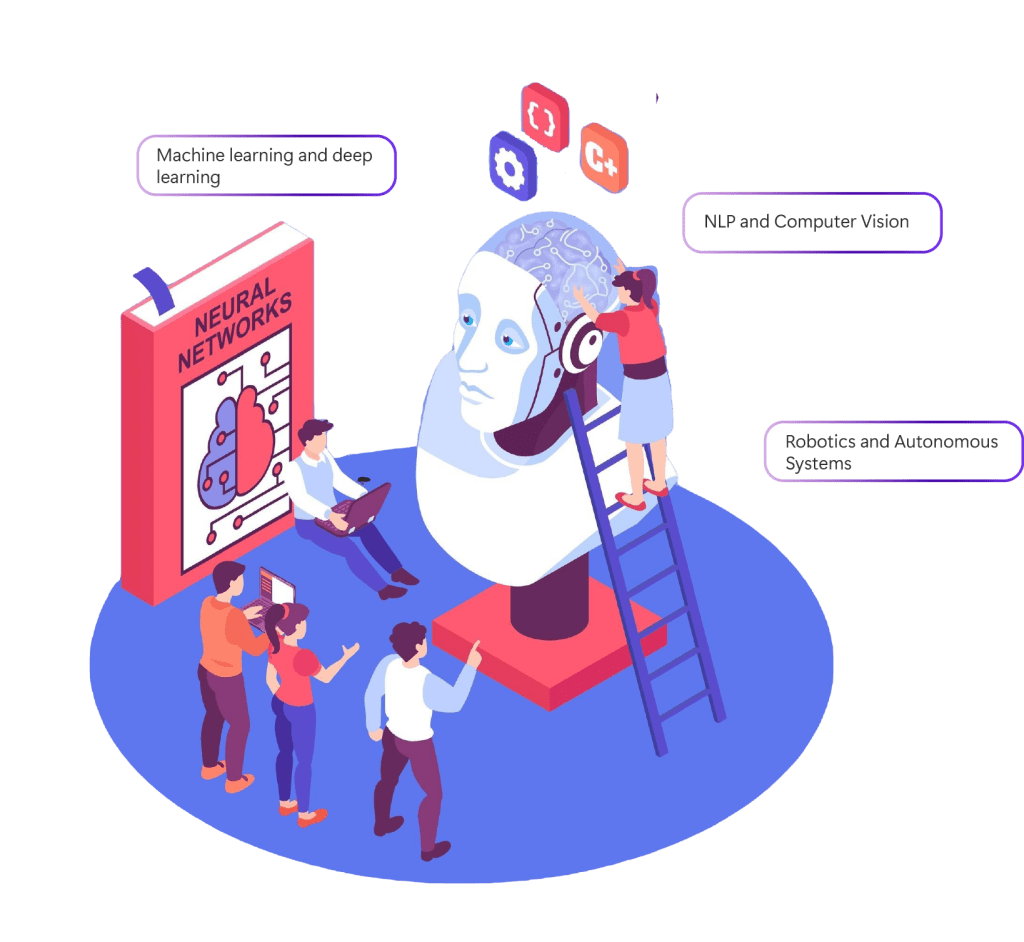
Machine Learning and Deep Learning:
- Machine learning involves training models on data to make predictions or take action, forming the backbone of many AI applications.
- Deep learning, a subset of machine learning, leverages neural networks to analyze and interpret complex data patterns. It excels in image recognition, speech processing, and natural language understanding.
- AI engineers use machine learning and deep learning techniques to create intelligent systems capable of analyzing data, learning from it, and making informed decisions.
Natural Language Processing (NLP) and Computer Vision:
- Natural language processing focuses on developing models to understand, interpret, and generate human language. Applications include chatbots, language translation, and sentiment analysis.
- Computer vision involves designing models that analyze and interpret visual data, enabling applications like object detection, facial recognition, and video analysis.
- AI engineers utilize NLP and computer vision to build systems that can interact with humans naturally and analyze visual information effectively, bridging the gap between technology and human communication.
Robotics and Autonomous Systems:
- Robotics integrates AI to develop systems that interact with and respond to the physical world. This includes robots used in manufacturing, healthcare, and service industries.
- Autonomous systems focus on creating models that enable machines to operate independently without human intervention. These systems demonstrate the power of AI in applications like self-driving cars, drones, and automated logistics.
- AI engineers work on robotics and autonomous systems to design intelligent machines capable of performing tasks in dynamic environments, pushing the boundaries of automation and innovation.
Education and Training
Educational Foundations for AI Engineers
A bachelor’s degree in computer science, information technology, or a similar discipline can help one gain a foundational understanding of programming, data structures, algorithms, and other essential ideas. An advanced degree in artificial intelligence can facilitate research possibilities, advanced machine-learning methods, and in-depth study of specialist AI topics.
Online courses and certifications for AI engineering
Use structured learning alongside working projects. Google’s Machine Learning Crash Course covers models, data, evaluation and production concepts. PyTorch’s beginner tutorial walks through a machine-learning workflow. A certificate can document learning, but it is not a substitute for demonstrating a tested system.
Importance of continuous learning and professional development
Keep a small evaluation set and rerun it when models, prompts, retrieval or dependencies change. Read release notes, record versions and compare results before upgrading a production system. Continuous learning should improve the quality of engineering decisions, not just expand the list of tools used.
Additionally, they stay current with the ever-changing AI landscape by integrating new technologies and trends into their work to be competitive in the sector, thanks to their agility and dedication to lifelong learning.
Essential Skills for AI Engineers
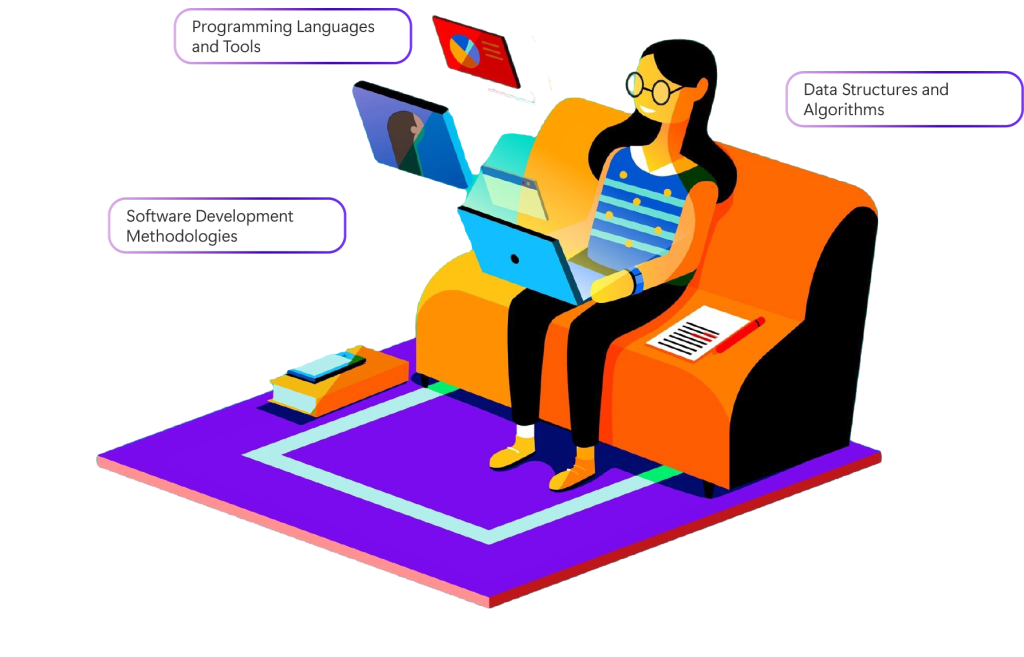
AI engineers must combine technical and soft skills to succeed in this dynamic field. Here are the key skills needed:
- Programming Languages and Tools:
- Build proficiency in one primary language, then add languages required by the application. Python offers useful data and machine-learning libraries; Java or C++ may be relevant to a particular production stack.
- Familiarity with machine learning frameworks like TensorFlow, PyTorch, and Keras enables engineers to build, train, and deploy sophisticated AI models efficiently.
- Data Structures and Algorithms:
- A firm grasp of data structures, including arrays, linked lists, trees, and hash tables, is essential for efficient data management and processing in AI projects.
- Knowledge of sorting, searching, graph traversal, and optimization algorithms is critical for implementing AI models and solving complex computational problems.
- Software Development Methodologies:
- Understanding agile and Scrum methodologies helps AI engineers collaborate effectively in team environments and adapt to project requirements.
- Proficiency in version control systems like Git is vital for managing code, tracking changes, and facilitating collaboration across distributed teams.
Applications of Artificial Intelligence
AI has become a transformative force across industries and domains, driving innovation and efficiency. Here are some notable applications:
- Industries and Domains That Use AI:
- Healthcare: AI is revolutionizing diagnostics, personalized medicine, and drug discovery, enhancing patient outcomes and reducing costs.
- Finance: Applications like fraud detection, algorithmic trading, and credit scoring make financial systems more secure and efficient.
- Transportation: AI powers autonomous vehicles, traffic management systems, and route optimization, improving safety and reducing congestion.
- Education: Intelligent tutoring systems, personalized learning paths, and AI-driven content creation are transforming education.
- Marketing and Customer Service: Chatbots, recommendation engines, and predictive analytics enhance customer engagement and drive business growth.
- Emerging Trends and Innovations:
- Explainable AI: As AI systems become more complex, explainability is becoming more critical to build trust and ensure accountability.
- Transfer Learning: This technique allows models to leverage pre-learned knowledge, reducing training time and improving performance on related tasks.
- Edge AI: Processing data locally on devices rather than in centralized data centers enables faster responses and enhances privacy.
AI-Powered Low-Code Platforms: A Game-Changer for Engineers
Low-code platforms powered by AI are transforming the way AI engineers build and deploy applications. These platforms offer several benefits:
Simplifying AI Workflows
Low-code platforms like ToolJet provide intuitive drag-and-drop interfaces that allow engineers to build and customize applications without writing extensive code. This accelerates development and reduces the time required to bring ideas to life.
Enhancing Collaboration
Use a shared review interface so domain experts can inspect inputs, model outputs, cited sources and failure cases. Capture corrections as evaluation evidence; do not automatically treat every reviewer response as suitable training data.
Reducing Complexity
By automating repetitive tasks and providing pre-built components, these platforms allow AI engineers to focus on more strategic aspects of projects, such as optimizing machine learning models and analyzing data.
Rapid AI Prototyping
For a first project, build a support-answer prototype over a small approved document set. Include questions with known answers, missing answers and restricted documents. Measure correctness, source support, permission failures, response time and cost. Provide a human-review fallback. Document the dataset, access rules, model and prompt versions, evaluation results, limitations and rollback procedure so another engineer can reproduce the work.
ToolJet can provide an internal application layer for review queues, model evaluation dashboards and data-connected interfaces. AI-generated pages and queries remain visually editable. Connecting a model through an integration or API is separate from training that model. Verify backend permissions and the deployment and AI data boundaries; app hosting alone does not determine where inference happens.
Preparing for an AI Engineering Career
Building a successful career in AI engineering involves a mix of education, networking, and staying current with industry trends. Here’s how to prepare:
Coursera and Other Online Learning Platforms:
- Platforms like Coursera, edX, and Udemy offer comprehensive courses and certifications in AI engineering, covering topics from basic programming to advanced machine learning.
- Online learning provides flexibility and access to resources from leading universities and organizations, making it an excellent starting point for aspiring AI engineers.
Building a Professional Network:
- Networking with professionals in the AI field can open doors to collaborations, mentorships, and career opportunities.
- Joining online communities like GitHub, Kaggle, or LinkedIn groups and attending AI conferences and meetups fosters connections with industry experts.
Staying Up-to-Date with Industry Developments:
- Following industry leaders, researchers, and organizations on platforms like Twitter and LinkedIn provides insights into the latest trends and innovations.
- Attending conferences, workshops, and webinars regularly, as well as reading industry publications and research papers, helps one stay informed about advancements in AI.
By mastering these skills, understanding applications, and actively engaging with the AI community, aspiring engineers can position themselves for a successful and impactful career in AI engineering.
Conclusion
AI engineering is a dynamic and rapidly evolving field that holds the potential to revolutionize industries and improve countless aspects of daily life. To thrive in this domain, professionals must prioritize continuous learning and professional development to keep pace with the latest advancements and emerging trends.
Building a strong professional network is essential for collaboration, mentorship, and accessing career opportunities. Engaging with online communities, attending industry events, and connecting with peers can provide valuable insights and support. Additionally, staying up-to-date with industry developments through conferences, publications, and thought leaders ensures that AI engineers remain at the forefront of innovation.
By cultivating these habits and committing to lifelong learning, aspiring and experienced AI engineers can make meaningful contributions to the field and drive impactful change in the world through artificial intelligence.